Kratom legality varies across the United States, and the answer to “Is Kratom legal in my state?” depends entirely on where state and local laws apply. While Kratom is not governed by a single nationwide rule, individual states and municipalities determine whether it is permitted, restricted, or prohibited.
This guide breaks down Kratom Legality by state, explains how federal law fits into the picture, and highlights local and international regulations to help clarify how Kratom laws differ across jurisdictions.
Table Of Contents:
- Kratom Legal Status Overview (2026)
- Federal Kratom Legality in the United States
- Kratom Legal Status by State
- Kratom Legality Outside the United States
- Why Kratom Legality Varies By Location?
- Recent Trends and Legal Developments
- Summary Of Kratom Legal Status
- Frequently Asked Questions
Kratom Legal Status Overview (2026)
➤ Federal Status: Not federally scheduled
➤ State Authority: Individual state law
➤ Statewide Bans: Yes (7 states)
➤ Local Restrictions: Yes (cities/counties)
➤ International Status: Varies by country
Federal Kratom Legality in the United States
At the federal level, Kratom is not listed as a controlled substance under the U.S. Controlled Substances Act. This means there is no nationwide ban enforced by federal law. However, the absence of a federal prohibition does not override the authority of states or local governments.
Federal agencies have periodically reviewed Kratom, but regulation and enforcement decisions are primarily left to individual states and municipalities. As a result, Kratom Legality in the U.S. operates under a decentralized legal framework.
Kratom Legal Status by State
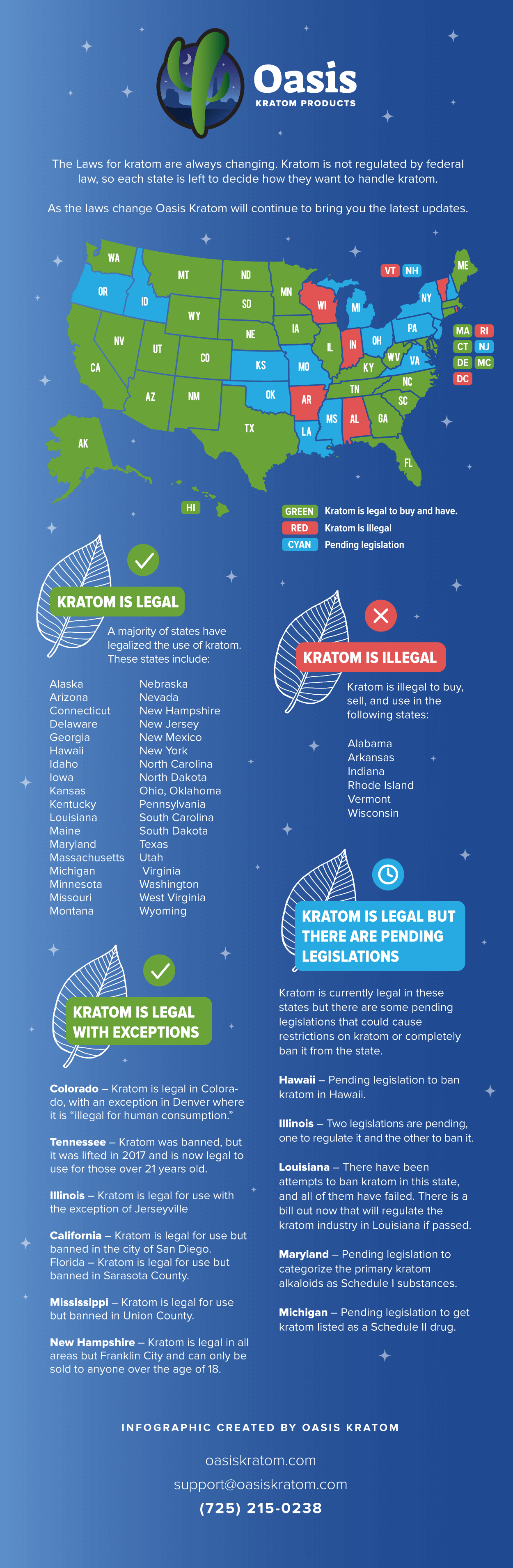
Kratom Legality varies significantly across the United States. Some states permit Kratom statewide, others have enacted full bans, and several allow it with specific regulations or local restrictions.
States Where Kratom Is Illegal
Kratom is currently illegal at the state level in the following locations:
- Alaska
- Arizona
- Connecticut
- Delaware
- Georgia
- Hawaii
- Idaho
- Iowa
- Kansas
- Kentucky
- Louisana
- Maine
- Maryland
- Massachusetts
- Michigan
- Minnesota
- Missouri
- Montana
- Nebraska
- Nevada
- New Hampshire
- New Jersey
- New Mexico
- New York
- North Carolina
- North Dakota
- Oklahoma
- Pennsylvania
- South Carolina
- South Dakota
- Texas
- Utah
- Virginia
- Washington
- West Virginia
- Wyoming
Important note:
Legal status at the state level does not prevent cities or counties within these states from adopting their own regulations.
States Where Kratom Is Legal With Restrictions
The following states allow Kratom under specific regulatory frameworks established by state law. These regulations typically govern classification, labeling, or distribution standards rather than imposing a full ban.
- Arizona- Sales are limited to individuals 18 and older; products must list alkaloid content and cannot contain synthetic additives or adulterants.
- Georgia- Retail sale requires age verification (18+), disclosure of alkaloid percentages on labeling, and prohibition of chemically altered Kratom products.
- Missouri- Kratom may not be sold to minors; products must meet labeling requirements and cannot include non-natural or adulterated ingredients.
- Nevada- Products must be accurately labeled and free from adulteration; sale of synthetic or misbranded Kratom is prohibited.
- Oklahoma- Retail distribution is restricted to adults 18+; labeling of alkaloid content is mandatory, and altered products are banned.
- Utah- Sale is limited to adults; product labels must disclose alkaloid content, and synthetic or adulterated Kratom is prohibited.
These states have enacted legislation that formally defines how Kratom is regulated at the state level rather than prohibiting it outright.
City & County Kratom Laws
Even in states where Kratom is legal, cities and counties may enforce their own ordinances. These local laws can restrict or prohibit Kratom within specific jurisdictions.
Examples of areas with local restrictions include:
- Certain counties in Florida
- Select cities in California
- Individual municipalities in Colorado
Because local regulations can change independently of state law, verifying city- or county-specific rules is essential when evaluating Kratom Legality.
| How to Verify Kratom Laws in Your Area? |
To confirm current Kratom laws, review:
Laws may change, so always rely on the most current sources. |
Kratom Legality Outside the United States
Kratom Legality is not limited to U.S. law. International regulations vary widely, with some countries permitting Kratom and others enforcing strict prohibitions.
Countries Where Kratom Is Illegal or Restricted
- Australia
- United Kingdom
- Japan
- South Korea
- Thailand (historically restricted, with evolving regulations)
Countries Where Kratom Is Legal or Unregulated
- Certain regions in Southeast Asia
- Parts of Europe with no explicit ban
International Kratom laws can be subject to rapid regulatory change, making ongoing review important.
Why Kratom Legality Varies By Location?
The fragmented legal landscape exists because Kratom regulation is influenced by:
- State legislative authority
- Local government ordinances
- Regulatory agency interpretations
- Ongoing legal and policy reviews
As a result, Kratom Legality is not static and can shift over time as laws are introduced, amended, or repealed.
Recent Trends and Legal Developments
In recent years, several states have reviewed Kratom-related legislation, focusing on classification and regulation rather than blanket bans. Some jurisdictions continue to evaluate proposed bills, while others revisit existing laws.
These developments underscore the importance of staying informed, as legal status may evolve with legislative activity at both the state and local levels.
Summary Of Kratom Legal Status
So, is Kratom legal? The answer depends entirely on jurisdiction. While Kratom is not federally banned in the United States, its legal status varies by state, city, and country. For anyone asking, “Is Kratom legal in my state?” reviewing current state and local laws remains the most reliable way to understand Kratom legality in 2026.
Because regulations can change, staying informed through updated legal resources is essential for maintaining awareness of current Kratom laws.
Frequently Asked Questions About Kratom Legality
Is Kratom legal nationwide?
No. While Kratom is not banned at the federal level, individual states and local governments set their own laws.
Can Kratom be legal in one city but illegal in another?
Yes. Local ordinances can override state-level legality in certain cities or counties.
Do Kratom laws change over time?
Yes. Kratom legality can change due to new legislation, court rulings, or regulatory updates.
Is Kratom legal outside the United States?
Kratom Legality varies internationally, with some countries allowing it and others enforcing strict bans.
References:
https://www.fda.gov/news-events/public-health-focus/fda-and-kratom
https://legislativeanalysis.org/kratom-summary-of-state-laws/
https://www.dea.gov/sites/default/files/2020-06/Kratom-2020_0.pdf
https://www.congress.gov/crs-product/LSB11082
https://www.sciencedirect.com/science/article/abs/pii/S1525505021001165



 Is Kratom Legal in Florida: 2025 Update on Laws and Restrictions
 Where To Buy Kratom Near me | Oasis Store Locator