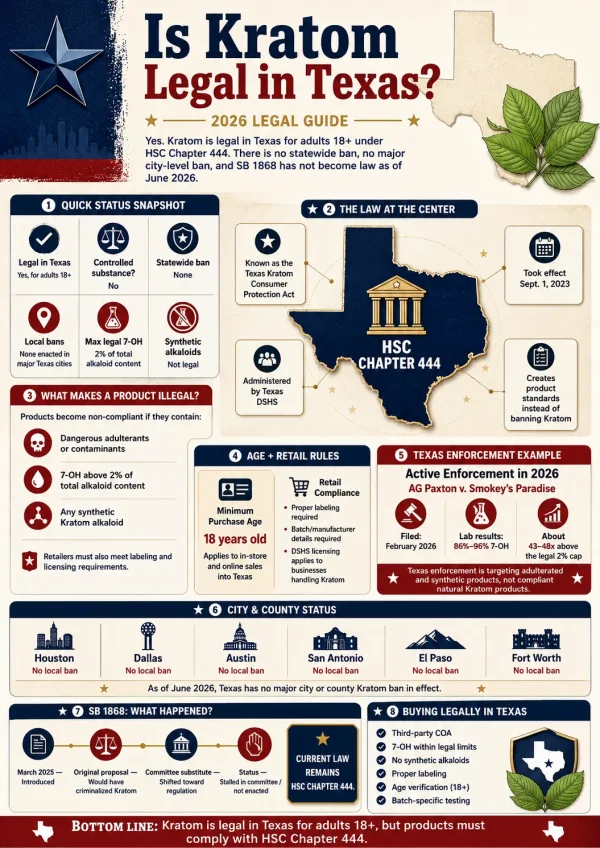
Kratom is legal in Texas for adults (18 and older) under Texas HSC Chapter 444. No statewide prohibition exists. No major Texas city has enacted a local ban. Pending legislation (SB 1868) has stalled in committee and has not become law as of June 2026.
This guide covers the answer to “Is Kratom legal in Texas?” by explaining the governing statute, regulatory requirements, active enforcement actions, pending legislation, and what legal Kratom purchasing looks like in Texas today. It is intended as an informational resource and not legal advice. For specific legal questions, consult a licensed Texas attorney.
Table Of Contents:
- Kratom Legal Status In Texas: Summary
- Governing Law: HSC Chapter 444
- Active Enforcement: AG Paxton v. Smokey's Paradise (February 2026)
- Municipal and County Regulations
- Pending Legislation: SB 1868 (89th Legislature)
- Buying Kratom in Texas: What You Need to Know
- FAQs
Kratom Legal Status In Texas: Summary
| Legal Question | Short Answer | Details |
| Is Kratom legal in Texas? | ✅ Yes, for adults 18+ | HSC Chapter 444 |
| Is Kratom a controlled substance in Texas? | ❌ No | Texas Controlled Substances Act |
| Are synthetic Kratom alkaloids legal? | ❌ No | HSC §444.003 |
| Maximum legal 7-OH concentration | 2% of the total alkaloid content | HSC §444.003 |
| Minimum legal purchase age | 18 years | HSC §444.004 |
| City or county-level bans? | None enacted as of June 2026 | — |
| Federal scheduling? | Not scheduled | DEA / CSA |
| FDA approval? | Not approved | U.S. FDA |
Governing Law: HSC Chapter 444
Legislative History
Texas enacted its Kratom regulatory framework through Senate Bill 497, signed into law during the 88th Legislative Session. The statutory provisions took effect on September 1, 2023, and were codified in the Texas HSC, Chapter 444.
- Popular name: Texas Kratom Consumer Protection Act
- Administering agency: Texas DSHS
- Legislative model: Consumer protection and product quality — not prohibition
The legislature's intent was not to ban Kratom but to establish minimum product standards, eliminate adulterated products from the market, and create an enforcement mechanism for non-compliant retailers.
Scope of the Law
HSC Chapter 444 applies to:
- Processors — entities that prepare Kratom products for retail sale
- Retailers — any business selling Kratom products directly to consumers
- Distributors and wholesalers — entities that move Kratom products through the supply chain
- Manufacturers — entities producing raw or processed Kratom for commercial sale
The law does not apply to private, non-commercial possession of Kratom by adults. There is no possession offense under HSC Chapter 444 or under the Texas Controlled Substances Act for naturally occurring Kratom leaf or compliant Kratom products.
Statutory Requirements for Products and Retailers
Product Prohibitions — HSC §444.003
A Kratom product is illegal to sell in Texas if it contains any of the following:
- A dangerous non-Kratom substance that adulterates the product
- A contaminant, poisonous substance, or non-Kratom compound at levels that render the product injurious
- 7-Hydroxymitragynine (7-OH) in excess of 2% of the product's total alkaloid content
- Any synthetic Kratom alkaloid — this includes synthetically produced mitragynine, synthetic 7-OH, and any other alkaloid synthetically derived from the Kratom plant, regardless of chemical equivalence to the natural compound
Note: 7-Hydroxymitragynine is a potent alkaloid found naturally in Kratom leaf at very low concentrations. Some manufacturers have adulterated products with synthetic or extracted 7-OH to enhance potency. Texas law caps this at 2%, a threshold that accommodates natural leaf content while prohibiting concentrated synthetic formulations.
Mandatory Labeling Requirements
Every Kratom product sold in Texas must carry a label that includes, at a minimum:
- Product information — as required by HSC Chapter 444 for consumer disclosure
- Batch-specific details — identifying the product and its manufacturer
- Manufacturer or distributor contact information — name and a means of contact (address, phone, or website)
Products sold without statutorily required labeling are non-compliant and subject to enforcement action regardless of whether the product itself meets alkaloid standards.
Age Restriction — HSC §444.004
- Kratom products may not be sold, delivered, or distributed to any person under 18 years of age
- The prohibition applies to both in-person retail and online sales with delivery into Texas
- Violation of the age restriction constitutes a Class C misdemeanor
- Repeated or egregious violations may also trigger civil penalties and DSHS administrative action
Business Licensing and Permits
Any entity that manufactures, stores, distributes, or retails Kratom products in Texas must hold the appropriate DSHS food licensing and permitting credentials. Operating without proper licensure while handling Kratom products is a separate regulatory violation from product non-compliance.
Active Enforcement: AG Paxton v. Smokey's Paradise (February 2026)
HSC Chapter 444 is actively enforced. In February 2026, Attorney General Ken Paxton filed a civil action under both HSC Chapter 444 and the Texas Deceptive Trade Practices Act (DTPA) against Kratom retailers operating as Smokey's Paradise in Midlothian, TX.
Lab testing found 7-OH concentrations of 86%–96% of total alkaloid content — approximately 43–48x the 2% statutory cap — alongside prohibited synthetic alkaloids.
AG Paxton stated publicly:
"Kratom is addictive and deadly, and I'm suing these companies for knowingly endangering Texans by selling products with nearly 50 times the legal limit of this opioid."
The action confirms that enforcement targets adulterated and synthetic products — not naturally occurring Kratom — and that the DTPA provides civil penalty exposure on top of HSC Chapter 444 violations. Vendors publishing batch-specific Certificates of Analysis (COAs) from accredited labs are the clearest demonstration of statutory compliance.
Municipal and County Regulations
Statewide Preemption
Texas has not enacted formal statutory preemption of local Kratom ordinances. However, as of June 2026, no major Texas municipality or county has enacted a local Kratom ban or restriction. The regulatory landscape is uniform statewide under HSC Chapter 444.
City-by-City Legal Status
| Municipality | Local Kratom Ordinance | Governing Law |
| Houston (Harris Co.) | None enacted | HSC Chapter 444 |
| Dallas (Dallas Co.) | None enacted | HSC Chapter 444 |
| Austin (Travis Co.) | None enacted | HSC Chapter 444 |
| San Antonio (Bexar Co.) | None enacted | HSC Chapter 444 |
| El Paso (El Paso Co.) | None enacted | HSC Chapter 444 |
| Fort Worth (Tarrant Co.) | None enacted | HSC Chapter 444 |
| Midland | None enacted | HSC Chapter 444 |
| Lubbock | None enacted | HSC Chapter 444 |
County-Level Status
The following counties have not passed any ordinances restricting Kratom possession, sale, or distribution:
- Harris County
- Dallas County
- Travis County
- Bexar County
- Tarrant County
- El Paso County
Contrast With Other States
Texas stands in contrast to states like California, where municipalities, including San Diego, have enacted local sales restrictions on Kratom despite no statewide prohibition. Texas's uniform state-level regulatory model means the legal standard is consistent regardless of which Texas city or county a purchase occurs in.
Note on Future Local Ordinances: While no Texas city has acted as of this writing, the absence of formal preemption means municipalities could, in theory, enact local restrictions. Buyers in Texas should monitor their local city council agendas if this is a concern, particularly if new state legislation creates a model for local action.
If you are looking to better understand the Kratom legal status throughout the United States, read our blog on “Is Kratom Legal?”
Pending Legislation: SB 1868 (89th Legislature)
Introduction and Original Provisions
Senate Bill 1868 was introduced by State Senator Charles Perry in March 2025 during the 89th Regular Legislative Session. In its original form, SB 1868 proposed a fundamental reclassification of Kratom under Texas criminal law:
- Add Mitragynine and 7-Hydroxymitragynine to Penalty Group 1 of the Texas Controlled Substances Act
- Penalty Group 1 includes heroin, fentanyl, methamphetamine, and other Schedule I/II analogs
- Criminal consequences would have included:
- Possession of any amount — state jail felony (minimum)
- Possession of larger quantities — first or second degree felony
- Distribution or sale — elevated felony charges
This version of the bill would have effectively criminalized Kratom possession for hundreds of thousands of Texas adults and made retail sale a felony offense.
| Community and Industry Response The bill's introduction generated organized opposition from Texas Kratom advocates and community members. Discussions on forums, including the Reddit community, served as early mobilization points, with Texans sharing information about the bill's progress and coordinating outreach to their representatives. |
Committee Substitute: From Criminalization to Regulation
The Texas Senate responded to industry and public stakeholder input by adopting a Committee Substitute for SB 1868, a substantially revised version that abandoned the Penalty Group 1 approach in favor of a strengthened regulatory model:
| Provision | Committee Substitute Detail |
| Statutory placement | Chapter 444 redesignated as Chapter 445 |
| Product testing mandate | Alkaloid content, heavy metals, microbial contaminants — tested by ISO/IEC 17025-accredited Texas laboratories |
| Minimum purchase age | Increased from 18 to 21 |
| Prohibited formats | Prepackaged Kratom beverages; certain synthetic product categories |
| Penalty tier | Class A misdemeanor for violations (elevated from Class C under current law) |
| Enforcement | Civil penalties and administrative action through DSHS |
Buying Kratom in Texas: What You Need to Know
Texas has approximately 205 active Kratom sellers statewide, from dedicated botanical shops to local shops to online vendors. Quality varies widely.
Local Shops vs. Online: Which Is Better To Buy Kratom In Texas?
| Factor | Local Shops | Online Vendors |
| COA availability | Often unavailable | Published by batch |
| Strain selection | Limited | Wide range |
| Alkaloid consistency | Variable | More consistent |
| Pricing | Higher (retail markup) | Better on bulk |
| Convenience | Immediate pickup | 2–4 day shipping |
Gas station Kratom in particular has historically underperformed on independent lab testing — and is precisely the segment Texas regulators have targeted.
What to Look for in Any Texas Kratom Vendor?
Whether you're buying Kratom in Houston or ordering online to Dallas, these are the non-negotiables:
✅ Third-party COA: lab reports confirming alkaloid content, heavy metals, and microbial testing
✅ 7-OH within legal limits: must not exceed 2% of total alkaloid content
✅ No synthetic alkaloids: product must be derived from natural Mitragyna speciosa leaf
✅ Proper labeling: batch number, serving size, manufacturer contact
✅ Age-gated sales: any retailer not verifying age (18+) is operating illegally
Oasis Kratom's Compliance Posture:
Oasis Kratom ships to all Texas addresses and operates in full compliance with HSC Chapter 444. Every product batch undergoes third-party laboratory testing through ISO/IEC 17025-accredited labs, with COAs available by batch number. All products are sold exclusively to adults 18 and older, with age verification at checkout.
FAQs
What Texas law governs Kratom?
Texas HSC (HSC) Chapter 444, or the Texas Kratom Consumer Protection Act, is the operative statute. It was enacted via Senate Bill 497 during the 88th Legislative Session and became effective September 1, 2023. It is administered by the Texas DSHS.
Is Kratom a controlled substance in Texas?
No. Kratom alkaloids, including Mitragynine and 7-Hydroxymitragynine, are not listed in any Penalty Group under the Texas Controlled Substances Act as of June 2026. SB 1868, which proposed adding them to Penalty Group 1, was not enacted. Kratom is regulated as a consumer product under HSC Chapter 444, not as a controlled substance.
What are the penalties for selling non-compliant Kratom in Texas?
Under HSC Chapter 444:
- Age restriction violation (selling to under-18) — Class C misdemeanor
- Product standard violations — subject to civil penalties and DSHS enforcement action
- Deceptive marketing of non-compliant products — civil liability under the Texas Deceptive Trade Practices Act (DTPA), as demonstrated by the AG Paxton enforcement action in February 2026
Is Kratom banned in any Texas cities?
No. As of June 2026, no Texas municipality — including Houston, Dallas, Austin, San Antonio, El Paso, or Fort Worth — has enacted a local ordinance banning or restricting Kratom. Texas state law (HSC Chapter 444) governs uniformly statewide.
Is Kratom legal in Houston specifically?
Yes. Kratom is legal for adults 18 and older in Houston, Texas. Harris County and the City of Houston have not enacted any local ordinances restricting Kratom sales, possession, or distribution. All Kratom products sold in Houston must comply with the statewide standards in HSC Chapter 444.
Can Texas raise the Kratom purchase age to 21?
Not under current law. The minimum purchase age under HSC Chapter 444 is 18. Senate Bill 1868's Committee Substitute proposed raising it to 21, but that bill has not been enacted. Any change to the purchase age would require new legislation to pass both chambers and be signed into law. As of June 2026, the legal purchase age remains 18.
Disclaimer: Texas Kratom laws are subject to legislative change. Always verify current regulations with your local authorities or legal counsel before purchasing.

 Is Kratom Legal in Louisiana? 2026 Legal Status Update
 Is Kratom Legal In Maine?