
Browse any reputable Kratom catalog, and you’ll spot something that doesn’t fit neatly into the standard lineup. Red, green, and white — then there’s Gold.
No Kratom tree grows a golden vein. Gold Kratom isn’t a natural leaf color. It’s a category earned entirely through craft processing, and that distinction is exactly what makes it worth understanding.
This guide covers:
- What Gold Kratom actually is (and isn’t)
- How it’s made — the four core methods
- How Gold compares to Yellow Kratom and the three primary vein colors
- How to choose between Gold Kratom powder and capsules
- What to watch for when evaluating vendors
What Is Gold Kratom?
The short answer: Gold Kratom is not a naturally occurring “vein color” like red, green, or white strains. Instead, it’s a processing-based category—meaning its identity comes from how the leaf is handled after harvest.
Here’s the distinction that matters:
- Red, Green, and White Kratom refer to distinct characteristics of the Mitragyna speciosa leaf, primarily associated with vein maturity and natural drying. These are part of how the leaf is grown and harvested.
- Gold Kratom, on the other hand, doesn’t exist in the plant in that form. Its golden or amber tone comes from post-harvest techniques such as controlled drying, light fermentation, and sometimes blending different leaf batches.
- Because of this, Gold Kratom can vary quite a bit from one vendor to another. In some cases, it’s carefully crafted through specific processing methods. In others, it may simply be a blend or rebranded version of existing strains with minimal additional refinement.
| The honest definition: Gold Kratom is a processed or blended category made through craft methods, and its quality varies significantly between vendors. |
The Science Behind Gold Kratom
Kratom’s identity as a botanical comes down to its alkaloids — primarily Mitragynine and 7-Hydroxymitragynine — plus dozens of minor supporting compounds.
When leaves are harvested and dried, alkaloid chemistry doesn’t stop:
- Oxidation continues
- Sun exposure, heat, and humidity interact with the raw leaf
- Some compounds gradually convert into others
Think of it like tea. A green tea leaf and a black tea leaf start from the same plant — different oxidation processes create different chemistry entirely.
Gold Kratom producers intentionally harness this. Extended drying times, fermentation windows, and precise blending ratios aren’t random choices. They’re designed to shift the alkaloid balance toward a profile that no single strain would achieve on its own.
The result is what botanicals experts describe as a “full-spectrum” alkaloid composition — one drawn from multiple processing stages rather than a single leaf maturity level.
How Gold Kratom Is Made: The Four Core Methods
There isn’t a single, standardized process that defines Gold Kratom. Instead, the “Gold” label usually comes from a few common production approaches used across the industry. Most products sold as Gold Kratom are created through one of these four primary methods:
Method 1: Extended Sun Drying (UV Oxidation)
- Green or white leaves are spread under direct sunlight for 15–20 days, far longer than standard drying
- Prolonged UV exposure oxidizes alkaloids, deepening color from green to warm yellow-gold
- One of the oldest craft methods used by Indonesian farmers in Borneo, Sumatra, and Bali
Method 2: Controlled Fermentation
- Leaves, often with red vein color, are placed in sealed containers for a short fermentation window (around two days)
- Fermentation matures the alkaloid profile, producing a richer color and a rounder finished product
- Shorter than traditional red Kratom fermentation, creating a distinct midpoint character
Method 3: Strain Blending
- Multiple strains combined in specific ratios — commonly red + green, sometimes with white added
- Draws on complementary alkaloid profiles to achieve the full-spectrum character Gold is known for
- Exact blend ratios are typically proprietary
Method 4: Selective Harvest Timing
- Leaves harvested at a precise maturity window — between peak green and full red
- At this stage, the leaf’s alkaloid composition is naturally in transition
- Combined with careful drying, produces an inherently blended profile before additional processing begins
In practice, Premium Gold Kratom is often created by combining two or more of these methods. For example, a Gold Bali may start with selectively harvested Bali-region leaves, followed by a brief fermentation step and a final sun-drying phase. The way these steps are combined and controlled is what ultimately defines the character of the final product.
Gold Kratom vs Yellow Kratom: Are They the Same?
Short answer: they’re related, but not identical.
Both Gold and Yellow Kratom are processed categories, not naturally occurring strains. Neither comes directly from a specific vein color on the Mitragyna speciosa plant. Instead, both are created after harvest through methods like extended drying, light fermentation, or blending different leaf batches. In many cases, vendors even use the terms interchangeably.
But there are some important distinctions:
| Features | Yellow Kratom | Gold Kratom |
| Processing | Extended drying / selective harvest timing | Fermentation + blending, often more intensive |
| Base Material | Typically green or white leaves | Red, green, white — or blended combinations |
| Color | Pale yellow to light gold | Warm gold to amber |
| Alkaloid Character | Lighter, gentler transition from green | Richer, more complex than yellow |
| Vendor Consistency | More standardized across vendors | Greater variation between vendors |
Think of Yellow as an earlier point on the post-harvest craft spectrum. Gold takes that processing further — through fermentation or multi-strain blending — to arrive at something more layered.
Since no regulatory body defines these terms, always read a vendor’s specific product description rather than relying on the label alone.
Know more about Yellow Kratom here.
Gold Kratom vs Other Kratom Strains
Gold vs Red Kratom
| Aspects | Red Kratom | Gold Kratom |
| Origin | Fully mature leaves, naturally red | Processed or blended post-harvest |
| Character | Deeply settled alkaloid profile | More moderate; shares some red character without the full intensity |
| Processing | Standard sun-drying | Extended drying, fermentation, or blending |
Learn all about Red Kratom with our guide.
Gold vs Green Kratom
| Aspects | Green Kratom | Gold Kratom |
| Origin | Mid-maturity leaves, air-dried | Processed from green or blended bases |
| Character | Classic “balanced” position | Carries Green’s approachability with added processing depth |
| Processing | Standard air-drying | Extended or blended methods transform the base |
Read about what characteristics make Green Kratom different.
Gold vs White Kratom
| Aspects | White Kratom | Gold Kratom |
| Origin | Young leaves, earliest harvest | Processed; may include white strains in blend |
| Character | Most sought-after alkaloid profile of the core three | White’s profile significantly moderated through blending/oxidation |
| Processing | Minimal drying | Extended processing transforms any white strain |
Check out our guide to know all about White Kratom.
The bottom line is this: Gold Kratom doesn’t sit clearly above or below other categories in a simple comparison. Instead, it exists as its own category, defined by how it is processed and blended.
Kratom and Modern-Day Marketing: What “Gold” Really Means on a Label
The word “Gold” has become a strong marketing signal in the Kratom industry, but it doesn’t always reflect a consistent standard across products.
Here’s what to keep in mind:
1. “Super Gold” and “Ultra Gold” are marketing terms
These labels are not defined production categories. A product called “Super Gold Kratom” may simply be standard Gold powder with upgraded branding. Without lab data, there’s no way to confirm whether it differs in composition.
2. Color alone doesn’t guarantee quality
A golden shade comes from processing methods, not a controlled visual standard. In some cases, color adjustments may come from shortcuts rather than traditional drying or fermentation techniques.
3. Blends are not standardized
Gold Kratom blends can vary widely between vendors. One batch may be red-heavy, another may lean green, and others may be based on a single fermented leaf type. The same “Gold” label can represent very different formulas.
What to look for instead:
- ✅ Batch-specific Certificates of Analysis (COAs) from accredited third-party labs
- ✅ Clear description of production method
- ✅ AKA (American Kratom Association) GMP certification
- ✅ Transparent sourcing information
- ❌ Vague “premium,” “super,” or “ultra” claims without lab data to back them
Common Gold Kratom Myths — Debunked
❌ Myth 1: Gold Kratom is a specific strain.
The truth: “Gold” describes a processing category, not a botanical strain.
No variety of Mitragyna speciosa has a golden vein color. The color and alkaloid character of Gold Kratom come entirely from what happens to leaves after harvest — through drying, fermentation, and blending.
❌ Myth 2: Gold Kratom is automatically stronger than other types.
The truth: Processing changes the alkaloid balance; it doesn’t uniformly increase potency.
A well-made Gold Kratom product has a different profile from a red, green, or white. Different and stronger aren’t the same thing. Lab-confirmed alkaloid percentages are the only valid measure of potency.
❌ Myth 3: Gold Kratom is rare or exclusive.
The truth: Extended drying, fermentation, and blending are established techniques practiced widely across Indonesian Kratom farming regions.
The category is widely produced. “Rarity” claims are a marketing frame — not a botanical reality.
✅ What is actually true about Gold Kratom:
- It undergoes a distinct drying and/or fermentation process that the standard Kratom strain does not
- It is a processed or blended product, and those blends vary widely across vendors
- Quality is determined by the rigor of the process and the transparency of the vendor, not by the “Gold” label alone
Gold Kratom Powders & Capsules: Choosing the Right Format
Both formats contain the same core product. The difference is format, not formula.
| Features | Gold Kratom Powder | Gold Kratom Capsules |
| Flexibility | High | Fixed per-capsule amount |
| Convenience | Requires handling | Ready to go, portable |
| Value per gram | Typically better | Slightly higher cost |
| Quality transparency | Easy to assess visually | Confirm the contents of the label |
| Best for | Those who prefer direct access | Those who prioritize a consistent routine |
When shopping either format, the quality checklist is identical:
- Third-party lab testing with publicly available COAs
- Clear production method disclosure
- AKA GMP certification
- Transparent sourcing
Gold Kratom Products Available at Oasis Kratom
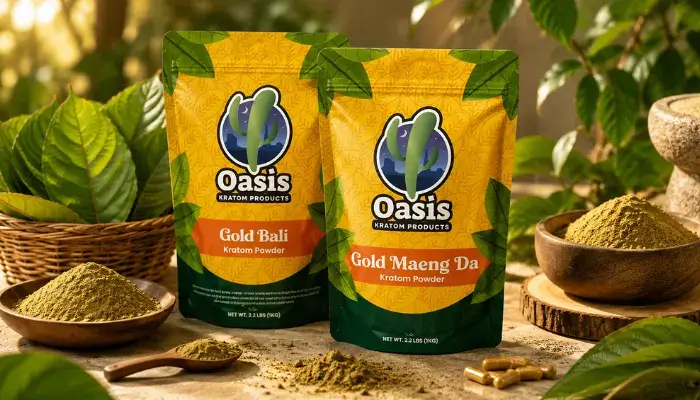
Oasis Kratom carries select Gold Kratom Powders that follow the same processing-based classification outlined above. These options feature on consistent sourcing and clearly defined post-harvest preparation methods.
Gold Bali Kratom Powder
A Gold variety made from Bali-region leaves, processed through extended drying and controlled oxidation methods that align with traditional preparation styles. This option is part of the Bali-origin lineup, where regional sourcing plays a key role in batch consistency.
Gold Maeng Da Kratom Powder
A Gold Kratom product based on Maeng Da leaf material, processed using multi-step techniques such as extended drying and blending to fit within this classification. This product represents a processed variation of the Maeng Da lineage rather than a single-vein strain profile.
Both options fall under the Gold Kratom category and reflect different base leaf origins and processing approaches, giving you a choice within the same craft-defined segment.
FAQs
1. Where does Gold Kratom come from?
Mostly Indonesia — primarily Borneo (Kalimantan), Sumatra, and the Bali region. These areas have the climate, soil, and farming expertise that make Indonesia the world’s dominant source of Kratom.
2. Is Gold Kratom stronger than red or green?
Not by definition. “Gold” is a processing label, not a potency ranking. Alkaloid content confirmed by lab testing is the only reliable strength indicator.
3. How should I store Gold Kratom?
Airtight container, cool and dark location — away from light, heat, and moisture. A pantry or cabinet works well. Avoid countertops or anywhere near a stove.
Read More: Where & How To Store Kratom?
4. How long does Gold Kratom powder stay fresh?
Up to 6–12 months with proper storage. Watch for faded color, clumping, or an off smell — those are signs the batch has degraded.
Learn More: What Is The Shelf Life Of Kratom?
5. Is Gold Kratom legal in the US?
Federally legal as of 2026, but several states have their own restrictions — including Alabama, Arkansas, Indiana, Louisiana, Vermont, and Wisconsin. Always check your state’s current laws before purchasing.
Read our detailed guide on Kratom legality here.
Disclaimer:
These statements have not been evaluated by the Food and Drug Administration. This product is not intended to diagnose, treat, cure, or prevent any disease. Kratom products are sold strictly for horticultural, research, and educational purposes only. Always verify the legal status of Kratom in your state or locality before purchasing.

 What Is Elephant Kratom? Why This Large-Leaf Strain Stands Out