Elephant Kratom stands apart from nearly every other strain on the market for one simple reason — its name tells you exactly what the leaf looks like, not just where it was grown.
Bali, Borneo, Sumatra, Maeng Da — nearly every Kratom strain gets its identity from a place on a map. Elephant Kratom gets its name from the leaf itself. These are leaves that can grow to several feet in length, droop heavily at the edges, and bear a silhouette so similar to an elephant’s ear that Indonesian harvesters gave it the name generations ago, and it has stuck ever since.
No branding team was involved. That kind of name — earned in the field, not invented in a marketing meeting — is worth understanding. Here’s everything you need to know about what Elephant Kratom actually is, where it comes from, and what sets it apart from the rest of the shelf.
Table Of Contents:
- What Is Elephant Kratom?
- Why Are Elephant Kratom Leaves So Large?
- What Makes Elephant Different From Regional Strains?
- The Different Elephant Kratom Varieties
- FAQs
- Final Thoughts
What Is Elephant Kratom?
Elephant Kratom is a variety of Mitragyna speciosa classified by the physical morphology of its leaves, not by where it grows.
Here’s the quick breakdown:
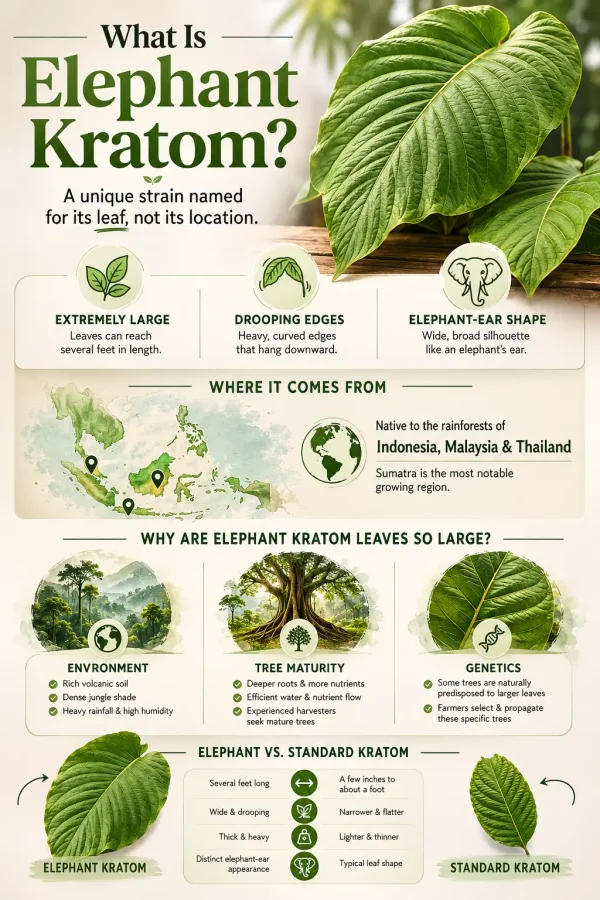
- Leaf size: Significantly larger than standard Kratom leaves, sometimes reaching several feet in length
- Leaf shape: Wide, heavy, and drooping at the edges, visually similar to an elephant’s ear
- Classification basis: Morphological (what the leaf looks like), not geographic (where it comes from)
- Primary origin: Indonesia, Malaysia, and Thailand, with Sumatra being the most notable growing region
- Tree type: Mitragyna speciosa; just from trees that develop this distinct, oversized leaf expression
Why Is It Called Elephant Kratom?
Elephant Kratom is named after the unique physical shape of its leaves. Here are the three physical traits that gave it its name:
🐘 Extreme size: The leaves dwarf standard Mitragyna speciosa foliage. Regular Kratom leaves typically range from a few inches to about a foot. Elephant Kratom leaves can reach several feet in length.
🐘 Drooping edges: The leaf margin hangs downward with a heavy, curved droop — not the flat, upright profile you’d see on most Kratom leaves.
🐘 Broad, ear-like shape: Taken together, the size and droop create a silhouette that closely resembles the wide, floppy ears of an elephant.
Why Are Elephant Kratom Leaves So Large?
Ever wonder why Elephant Kratom leaves grow so massive? It isn’t just a random evolutionary twist—this giant foliage is actually a byproduct of perfect timing, environment, and genetics.
These three interconnected factors drive this distinctive growth pattern:
🌍 Geographic Origin & Wild Growth Conditions
Elephant Kratom is native to the hot, highly humid equatorial rainforests of Southeast Asia, primarily Indonesia, Malaysia, and Thailand.
What makes these environments produce oversized leaves:
- Volcanic soil: Rich in minerals like potassium, phosphorus, and magnesium, which fuel expansive leaf development.
- Dense jungle canopy shade: Low light penetration triggers trees to develop broader leaves as a natural adaptation to capture more available sunlight.
- Heavy tropical rainfall: Consistent high moisture levels enable faster, more expansive leaf cell development.
- High humidity: Equatorial humidity levels (often above 80%) reduce plant water stress and support large-scale leaf growth.
The key insight here is that these wild, jungle-floor conditions are not replicated on a typical plantation. Elephant Kratom’s leaf profile is partly a product of genuinely wild, unmanaged growing environments that are increasingly difficult to source from.
🌳 Tree Maturity
Leaf size in Mitragyna speciosa changes significantly as a tree ages. Here are some reasons why older, mature trees are important for this strain:
- Deeper root systems: Mature trees access a broader, deeper range of soil nutrients unavailable to young trees.
- More developed vascular systems: An established vascular network moves water and nutrients more efficiently through the tree, supporting larger leaf development.
- Altered chemical makeup: In the botanical world, older trees often produce foliage with a noticeably different compound profile than that of younger specimens.
- Selective harvesting: Experienced Indonesian harvesters specifically seek out older, structurally mature trees when sourcing this strain.
🧬 Genetics
Not every Mitragyna speciosa tree in Sumatra will produce elephant-ear-shaped leaves, even when growing in the same soil, under the same canopy, at the same maturity level.
What the genetic factor means in practice:
- Certain trees carry traits that predispose them to larger, broader leaf expression.
- Over generations, Indonesian farmers have learned to identify and prioritize these specific trees.
- In some cases, cuttings from known elephant-ear-like trees are propagated to preserve the morphology across harvests.
This genetic selectivity is why authentic Elephant Kratom can’t simply be grown anywhere; it requires the right tree, not just the right environment.
Does Larger Leaf Size Mean Higher Potency?
This is one of the most common questions about Elephant Kratom — and the answer is more complicated than a simple yes or no.
Why Leaf Size and Alkaloid Content Aren’t Directly Correlated
The key bioactive compounds in Kratom leaves, primarily Mitragynine and 7-Hydroxymitragynine, are synthesized in specialized leaf tissue throughout the plant.
Here’s what actually drives alkaloid content:
- Soil nutrient profile: Rich, mineral-dense soil (like Sumatra’s volcanic base) supports more active alkaloid synthesis than depleted soils.
- Wild growth conditions: The tree’s exposure to environmental stressors triggers the production of defensive chemical compounds; farmed trees in controlled conditions produce differently than wild-grown ones.
- Genetic expression: The specific tree’s genetic traits influence how actively it synthesizes alkaloids.
- Leaf maturity at harvest: Alkaloid concentrations shift throughout the leaf’s life cycle; harvest timing matters enormously.
| What leaf size signals (but doesn’t guarantee): A large Elephant leaf is associated with a mature tree growing in nutrient-rich, wild conditions, and those conditions tend to support robust alkaloid development. Size is a proxy indicator of favorable growing conditions, not a direct cause of higher potency. Think of it like single-origin coffee: the altitude and soil that produce smaller, denser beans often correlate with more complex flavor, but it’s the environment doing the work, not the bean size itself. |
The Role of Harvesting and Processing
Leaf size does create a meaningful advantage at the harvesting and processing stage:
- Visual quality control in the field: Harvesters can immediately identify mature, full-grown Elephant leaves, making field-level quality selection more reliable.
- Consistent maturity at processing: Large-leaf material tends to come from a similar stage of development, yielding a more uniform powder.
- Processing variables that matter: Crucial factors such as drying methods, light exposure, grind consistency, and post-processing storage directly determine the final product’s quality.
At Oasis Kratom, every Elephant Kratom batch is sourced from farms that take harvest maturity and processing care seriously because that’s where quality is made or lost, regardless of leaf size.
Read more about Kratom Harvesting: How to Grow Kratom?
What Makes Elephant Different From Regional Strains?
While most strains are named after the specific geographic areas where they grow, Elephant Kratom stands out because it is classified entirely by its physical traits and maturity.
Elephant Kratom vs Maeng Da
| Feature | Elephant Kratom | Maeng Da |
| Named for | Leaf morphology (size + shape) | Quality descriptor/processing standard |
| Origin | Indonesia, Malaysia, Thailand | Thailand, Indonesia, Malaysia |
| Leaf appearance | Large, droopy, ear-shaped | Typically, darker, jagged edges |
| Classification basis | Observable physical leaf traits | Selective grafting/harvesting quality |
| Varieties available | White, Red, Green | White, Red, Green |
Key distinction: Maeng Da (loosely “pimp grade” in Thai) is a quality label applied to selectively harvested, high-grade Kratom. It’s a processing classification. Elephant Kratom is defined by a genuinely observable physical characteristic of the leaf itself.
Learn about Maeng Da Kratom in detail.
Elephant Kratom vs Horned Kratom
| Feature | Elephant Kratom | Horned Kratom |
| Named for | Large, droopy leaf shape | Pointed, horn-like serrations on leaf edges |
| Primary origin | Indonesia (mainly Sumatra) | Indonesia (mainly Borneo/Kalimantan) |
| Defining leaf trait | Oversized, ear-like droop | Normal size, irregular spiky edges |
| Classification type | Morphological | Morphological (genetic mutation) |
| Relative availability | Rare but findable | Among the rarest Kratom varieties |
Key similarity: Both Elephant and Horned Kratom are named for leaf morphology, and not region. Both attract buyers seeking something beyond standard regional destinations such as Bali and Borneo.
The Different Elephant Kratom Varieties
Like all Kratom, Elephant is available in three primary vein colors, each representing a different stage of leaf maturity at harvest and a different processing approach.
White Elephant
- Harvested from young, immature Elephant leaves before the central vein has fully developed
- Processed with shorter drying times, typically indoors away from direct sunlight
- Represents the earliest stage of the Elephant leaf life cycle
Read more about White Elephant Kratom strain.
Red Elephant
- Harvested from fully mature Elephant leaves at the deepest stage of the leaf life cycle
- Dried in direct sunlight or through extended, fermentation-style processing
- Represents peak maturity — the largest, most fully developed leaves on the tree
Know more about Red Elephant Kratom here.
Green Elephant
- Harvested at mid-maturity, when the central vein shows its green coloration
- Dried through a combination of indoor and outdoor methods, or through controlled blended techniques
- Sits between White and Red strains in terms of the leaf development spectrum
Learn about the Green Elephant Kratom strain in detail.
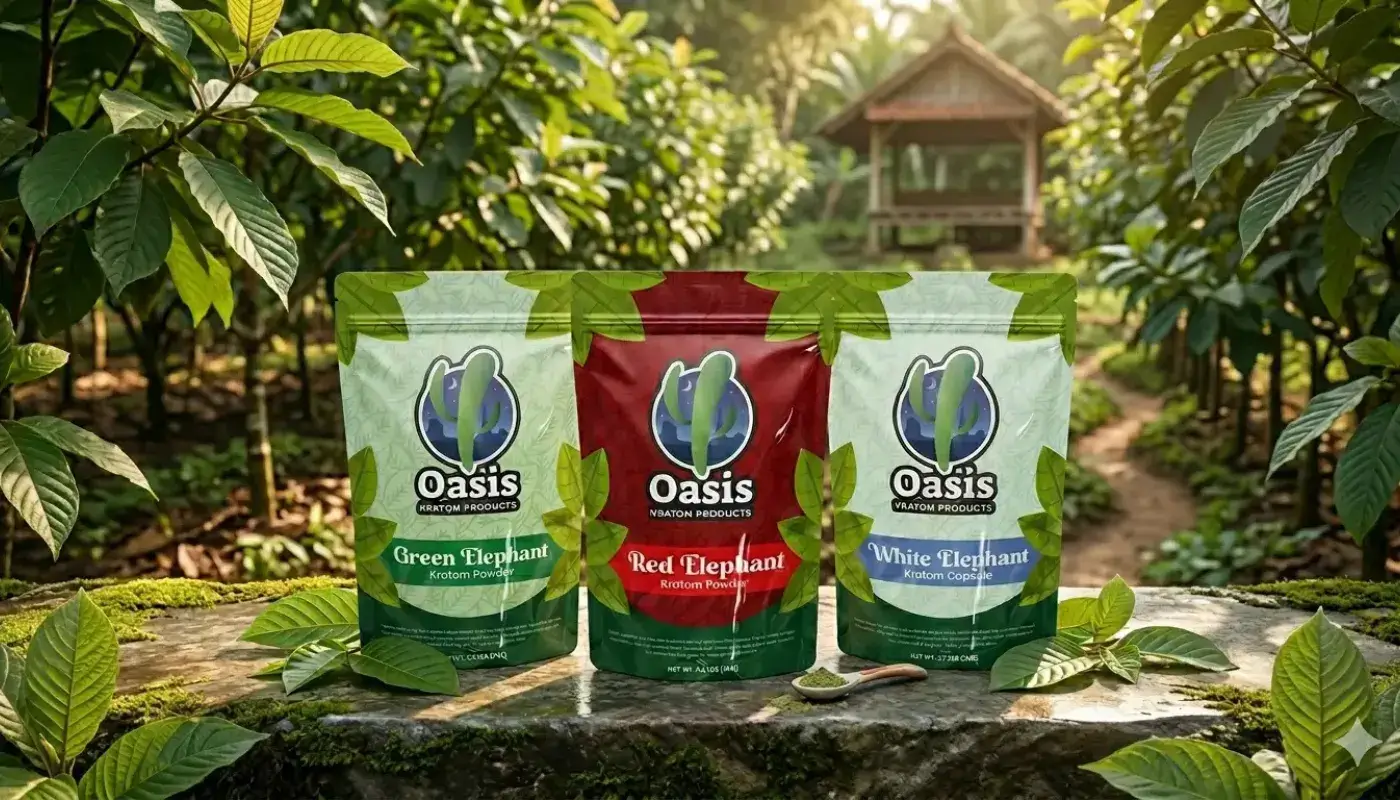
Looking for quality-verified Elephant Kratom? Oasis Kratom offers White Elephant, Red Elephant, and Green Elephant Kratom — each batch independently lab-tested for alkaloid content and purity.
FAQs
1. Does Elephant Kratom come from one specific region?
No. Elephant Kratom is found across Indonesia, Malaysia, and Thailand, though Indonesia—particularly Sumatra—is the most common source. The name refers to its unusually large leaves rather than a single growing region.
2. Is Elephant Kratom stronger than Maeng Da?
Not necessarily. Maeng Da and Elephant Kratom are classified differently, and neither is automatically stronger than the other. Alkaloid levels can vary from batch to batch based on harvest and processing factors.
3. Are Elephant leaves actually larger than regular Kratom leaves?
Yes. Elephant Kratom is known for its oversized leaves, noticeably larger than those of typical Mitragyna speciosa. This distinctive leaf size is what gives the variety its name.
4. Can two Elephant Kratom batches feel different?
Yes. Because Elephant Kratom is identified by leaf size rather than a specific genetic line, differences in growing conditions, harvest timing, and processing can lead to variation between batches.
5. Is Elephant Kratom common or hard to find?
Elephant Kratom is generally less common than mainstream varieties such as Bali or Maeng Da. While many vendors carry it, availability and authenticity can vary depending on sourcing practices.
6. Is Elephant Kratom a real strain or a classification?
It is generally viewed as a classification. The term refers to Kratom with exceptionally large, broad leaves rather than to a unique cultivar, and similar leaf characteristics can occur in different growing areas.
Final Thoughts
Elephant Kratom stands out for its unusually large, drooping leaves rather than for a specific geographic origin. While leaf size alone does not determine alkaloid content or product quality, it reflects a distinctive botanical characteristic that has made Elephant one of the most recognizable morphology-based Kratom classifications.
Understanding what the name actually refers to can help buyers separate plant traits from marketing labels when comparing different Kratom varieties.
Disclaimer: This article is intended for educational and informational purposes only. Kratom classifications, strain names, and botanical descriptions are based on industry terminology, grower practices, and available research, which may vary between sources and regions. Product characteristics can differ due to genetics, growing conditions, harvesting methods, and processing techniques.
This content is not intended to provide medical advice, diagnose, treat, cure, or prevent any disease. Always review local laws and regulations regarding Kratom before purchasing or possessing any Kratom products.

 What Is Gold Kratom? Understanding This Premium Category