The Kratom market is large, growing, and largely unregulated at the federal level. That combination creates a real problem: without a binding quality framework, the difference between a responsibly manufactured Kratom product and one that has never been tested for contaminants can be impossible to detect from the outside.
Kratom GMP certification exists to change that. Administered by the American Kratom Association (AKA), the GMP Standards Program provides Kratom vendors with a rigorous, independently verified path to demonstrate that their products meet defined quality and purity standards — and gives buyers a clear way to confirm it.
This guide explains exactly what the program requires, how the AKA GMP certification process works step by step, what auditors examine, and what GMP certification does and does not guarantee. If you want to understand what separates certified Kratom powder from uncertified alternatives, this is the full picture.
What Is Kratom GMP Certification?
Kratom GMP certification is a voluntary quality assurance program developed by the American Kratom Association (AKA). It verifies that vendors adhere to strict manufacturing standards, sanitation protocols, documentation practices, and Kratom lab testing requirements aligned with FDA Good Manufacturing Practices, ensuring consistency and traceability across products.
The Role of 21 CFR Part 111
The AKA GMP Standards Program is modeled directly on 21 CFR Part 111 — the FDA’s current Good Manufacturing Practice regulations for dietary supplements. This is the same federal regulatory framework that governs vitamins, botanical extracts, and similar products sold through licensed retailers.
While Kratom is not currently classified as a dietary supplement by the FDA, the AKA adopted 21 CFR Part 111 as the structural basis for its own Kratom quality standards program, applying the same rigor to Kratom that federal law demands from supplement manufacturers.
Why Did The Kratom Industry Adopt Its Own GMP Framework?
Because federal oversight of Kratom remains unresolved, there is no mandatory national quality standard for Kratom vendors. In 2019, the AKA launched its GMP Standards Program to fill that gap, creating a voluntary but independently verified certification that holds participating vendors to the same documentation, testing, and manufacturing standards applied to regulated dietary supplements.
Vendors that achieve AKA GMP Qualified status have passed a third-party audit confirming they meet these standards. Those that have not are operating without any external verification, regardless of what their marketing claims.
What Is The AKA GMP Standards Program?
The AKA GMP Standards Program evaluates vendor compliance across the full product lifecycle: manufacturing, processing, packaging, storage, distribution, and labeling. The program requires vendors to demonstrate — through documented systems and third-party inspection — that their products meet specifications for identity, purity, strength, and composition, and that their labels provide all information buyers need to make an informed purchase decision.
Key areas covered include:
- Written Standard Operating Procedures (SOPs) for every stage of production
- Controlled facility environments that prevent cross-contamination
- Batch tracking and full traceability from raw material to finished product
- Third-party Kratom lab testing on every batch
- Labeling that meets the AKA’s Kratom Consumer Protection Act (KCPA) model standards
- Staff training, documentation, and competency verification
- A recall system enabling any batch to be pulled from distribution
| GMP 4.0: The Most Recent Update The AKA has updated its program to GMP 4.0 — the most current version of the standard. GMP 4.0 reflects a more comprehensive evaluation of the complexity of bringing a Kratom product to market, including stricter labeling requirements and an expanded scope of manufacturer documentation. All vendors seeking or maintaining AKA GMP Qualified status must comply with GMP 4.0 requirements. No competitor currently covers this update in depth, making it an important detail for buyers evaluating vendor currency and credibility. |
The Quality Problem That Kratom GMP Certification Was Built to Solve
How Does Kratom Sourcing Create Quality Risks?
Kratom leaves are primarily harvested in Indonesia, where quality control practices can vary widely. By the time raw material reaches the United States, it has often been dried, processed, and packed under conditions that may not align with modern manufacturing standards
Open-air drying can expose leaves to insects, birds, and environmental contaminants, while some facilities lack structured sanitation protocols, introducing risks early in the supply chain.
Common contamination concerns include Salmonella, E. coli, coliform bacteria, yeast, mold, and heavy metals like lead and cadmium. These are the exact risks that GMP standards and third-party lab testing are meant to identify and control.
The Gap Between Raw Kratom and GMP-Certified Products
After import, vendors’ handling practices can differ significantly. Some repackage bulk material without testing or documentation, while others operate in controlled environments with trained staff and verified lab results. To a buyer, these differences are not always visible.
Kratom GMP certification is designed to close this gap by relying on independent third-party audits rather than self-reported claims, creating a consistent, verifiable standard across products.
| Why Kratom GMP Certification Matters for Buyers Without GMP-backed testing and batch-level documentation, there is no reliable way to verify product quality. GMP certification introduces accountability through audits, providing a clear, standardized benchmark that buyers can trust. |
How Kratom GMP Certification Works (Step-by-Step Process)
Achieving AKA GMP Qualified status is not a self-reported designation. It follows a defined, audited sequence of steps:
Step 1: Review and Registration
Vendors review the AKA GMP Standards Requirements and Terms and Conditions, submit a registration form and annual fee to the AKA, and complete an orientation call with AKA staff.
Step 2: The 90-Day Audit Window
From the date of registration, vendors have 90 days to complete their audit. This window is when all internal systems, documentation, and facility conditions must be brought into full compliance with program requirements.
Step 3: Vendor Preparation
Some vendors hire outside consultants to reach compliance. The AKA can recommend pre-approved consultants. Labeling is also reviewed during this stage to confirm it meets GMP 4.0 labeling requirements.
Step 4: Third-Party Facility Audit
The vendor contacts an AKA pre-approved auditor — not just any third party, but one specifically vetted and authorized by the AKA. The auditor conducts a physical inspection of the facility, reviews all documentation, and evaluates production and testing procedures.
Step 5: AKA Review
The completed audit report is submitted to the AKA, which reviews it within three business days. If findings require correction, the vendor must resolve all deficiencies before qualification is granted.
Step 6: Annual Renewal
Qualification is not permanent. Every AKA GMP Qualified vendor must pass an annual audit and pay the annual registration fee to maintain their status. A vendor that qualified two years ago but has not renewed is no longer current.
| Important distinction: All auditors and testing laboratories used in the AKA GMP Standards Program must be pre-approved by the AKA. Third-party verification alone is not sufficient — the third party itself must meet AKA qualification standards. |
How AKA GMP Audits Work and What Inspectors Check?
A third-party GMP audit is a comprehensive operational review, not a paperwork check. Auditors evaluate multiple dimensions of a vendor’s facility and practices:
Facility and Sanitation Standards
Auditors inspect whether manufacturing and storage environments are clean, organized, and free from conditions that could cause cross-contamination.
This includes pest control, proper humidity and temperature controls, and equipment that is appropriately maintained, calibrated, and fit for purpose.
Standard Operating Procedures and Documentation
Does the vendor have written SOPs for every production stage — raw material receiving, quarantine, processing, packaging, and distribution? Are those procedures actually followed, documented, and accessible?
SOPs must be written clearly and followed consistently by trained personnel.
Kratom Lab Testing Requirements
Every batch must be tested at an AKA-approved laboratory before it is released for sale. Auditors verify that testing protocols are in place, results are reviewed, and that no batch reaches the market without documented, passing lab results.
This is what distinguishes certified Kratom powder from products that carry no external verification.
| Kratom Lab Testing Requirements Under AKA GMP Regulations Third-party lab testing is a key part of GMP-compliant Kratom. Before any batch reaches the market, it is screened for:
If a batch fails any of these checks, it cannot be released. Each product is also tied to documented lab results through a Certificate of Analysis, allowing buyers to verify testing details for specific batches. |
Labeling and Traceability
Can every finished product be traced back to the specific raw material batch it came from? Are lot and batch numbers accurately assigned, recorded, and visible on product labels? Does labeling comply with KCPA model standards — including accurate ingredient disclosure and required product information?
These are all auditor checkpoints.
Personnel Training and Hygiene
Auditors confirm that staff are trained, that training is documented, and that hygiene and handling protocols are consistently observed throughout the facility.
Certified Kratom Powder vs. Non-Certified Products — What’s the Difference?
When comparing certified Kratom powder from an AKA GMP Qualified vendor against non-certified alternatives, the differences are easy to identify.
| Factor | AKA GMP Qualified Vendor | Non-Certified Vendor |
| Batch Testing | Every batch, third-party, AKA-approved lab | No requirement; at vendor’s discretion |
| Facility Standards | Audited annually by an AKA-approved inspector | No external verification |
| Documentation | SOPs, batch records, and traceability are required | No standardized documentation requirement |
| Labeling | KCPA-compliant labeling with lot numbers | No verified labeling standard |
| Recall Capability | Must have a documented recall system in place | No requirement |
| Verification | Listed on AKA’s public Qualified Vendor list | No public verification available |
| Annual Accountability | Must renew and pass the audit every year | No ongoing accountability |
What Kratom GMP Certification Does NOT Guarantee
Understanding the limits of GMP certification is as important as understanding what it covers. The AKA is explicit about this in its program documentation.
- Focuses on manufacturing processes and documentation—not individual product quality
- Does not indicate any product endorsement or approval by AKA
- Not FDA-approved and not evaluated under federal supplement standards
- Does not guarantee outcomes or replace regulatory oversight
- Requires annual renewal—certification is not permanent
Can a Vendor Lose GMP Certification?
Yes. The AKA reserves the right to remove or suspend a vendor’s Qualified status under several circumstances. This accountability structure is part of what makes the designation meaningful.
Grounds for removal or suspension include:
- Failure to maintain the GMP program’s required standards
- Failure to pay the annual registration fee
- Failure to submit an annual audit from an AKA-approved auditor
- Failure to correct deficiencies identified in an audit report
- Multiple reports of adverse events associated with the vendor’s products
A GMP Qualified listing is not a lifetime award. It reflects a vendor’s current operational standing, and the AKA has established clear mechanisms to revoke it when standards are not met.
How To Verify A Vendor’s Kratom GMP Certification?
The most reliable way to confirm that a Kratom vendor holds current AKA GMP Qualified status is to check the AKA’s official Qualified Vendor list directly at americankratom.org/gmp-qualified-vendors.
This list is maintained by the AKA and reflects current certification standing.
Reputable GMP-certified vendors also:
- Display their AKA GMP Qualified status visibly on their website
- Provide certificates of analysis (COAs) for specific product batches on request
- Assign traceable lot numbers to every product, linking it to the corresponding lab results
- Are willing to answer direct questions about their auditors, testing labs, and documentation practices
If a vendor claims GMP compliance but does not appear on the AKA’s current vendor list and cannot provide third-party lab results tied to specific batch numbers, their claim is unverified — regardless of what their packaging states.
Inside Oasis Kratom’s GMP-Compliant Process
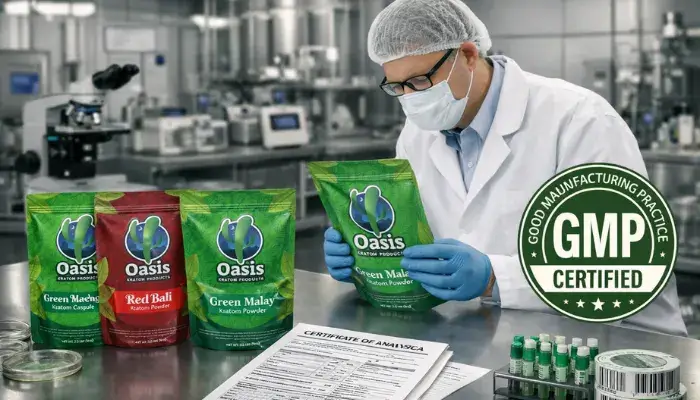
Oasis Kratom operates as an AKA GMP Qualified vendor, with every product handled under established GMP-aligned standards. This includes documented SOPs, routine facility audits conducted by AKA-approved inspectors, and third-party lab testing performed on each batch before it reaches the market.
This isn’t positioned as a claim—it’s a process that is independently audited each year and listed on the AKA’s Qualified Vendor program.
Every batch is tied to verifiable records, with COAs and lab results available upon request, and products labeled with traceable lot numbers linked to those results.
For buyers, this means there is a clear system behind how products are handled, tested, and documented.
| Want to verify our AKA GMP certification? You can confirm Oasis Kratom’s current certification status by visiting americankratom.org/gmp-qualified-vendors and searching for Oasis Kratom. For any questions around processes, audits, or testing protocols, the team is available to provide direct clarification. |
FAQs
1. What does ‘AKA GMP Qualified’ actually mean?
It means the vendor passed an independent third-party audit — conducted by an AKA pre-approved auditor — confirming that their facilities, documentation, and production processes meet the AKA GMP Standards Program requirements. It certifies process and manufacturing practices, not any specific product.
2. Is Kratom GMP certification the same as FDA approval?
No. Kratom GMP certification is a voluntary, industry-administered program modeled on FDA dietary supplement regulations (21 CFR Part 111). Kratom is not currently FDA-approved. The AKA GMP program operates independently of federal oversight and does not confer any regulatory status under FDA law.
3. How often do GMP-certified vendors get audited?
At a minimum, once per year. Vendors must pass an annual independent audit from an AKA-approved auditor to maintain their AKA GMP Qualified status. Qualification lapses if the annual audit is not completed or fees are not paid.
4. How do I verify that a vendor is currently GMP certified?
Check the AKA’s live Qualified Vendor list at the official website. Because certification must be renewed annually, the current listing status is the only reliable confirmation. A historical claim of past certification does not confirm present status.
5. Does GMP certification cover every product a vendor sells?
AKA GMP qualification covers the vendor’s overall manufacturing and labeling practices. Individual batch COAs (certificates of analysis) are what confirm that specific products passed Kratom lab testing. Both the vendor certification and product-level COAs matter.
6. What do GMP-certified Kratom products look like?
GMP-certified kratom products usually show clear signs of traceability and quality control. Buyers may notice lot or batch numbers on the label, access to batch-specific lab results or Certificates of Analysis, and packaging that includes complete product information instead of vague claims.
Reputable vendors also make their AKA GMP Qualified status easy to verify and maintain consistent labeling across their product range.
7. Why does certified Kratom powder sometimes cost more than uncertified alternatives?
GMP compliance carries real operational costs: third-party lab testing runs approximately $200–$500 per batch, facility upgrades can reach tens of thousands of dollars, and audits, staff training, and ongoing documentation add further expenses.
These costs reflect genuine investment in Kratom quality standards — and explain why vendors cutting corners on quality can price lower.
Disclaimer
These statements have not been evaluated by the Food and Drug Administration. This product is not intended to diagnose, treat, cure, or prevent any disease. The AKA GMP Qualified designation indicates compliance with the AKA’s manufacturing standards program and does not constitute FDA approval. Must be 21 years or older to purchase Kratom.

 Mystic Island Kratom Vendor Review
 Kratom One Vendor Review