If you've spent any time researching Kratom, you've almost certainly come across the term KCPA. It shows up in vendor disclaimers, advocacy updates, and state legislation news — but what does the Kratom Consumer Protection Act actually do, and why does it matter to you as a buyer?
This guide breaks it all down: what the KCPA is, what it requires of vendors, which states have passed it, and how it changes what you can expect when purchasing Kratom products.
Table Of Contents:
- What Is the Kratom Consumer Protection Act?
- KCPA Requirements: Lab Testing, Labeling, Age Verification & GMP
- Kratom Regulation by State: Which States Have Passed the KCPA?
- Why the KCPA Exists: The FDA Regulation Gap
- KCPA vs Unregulated Kratom Markets: What Changes for Buyers
- The KCPA’s Role In Preventing Future Kratom Bans
- Frequently Asked Questions
What Is the Kratom Consumer Protection Act?
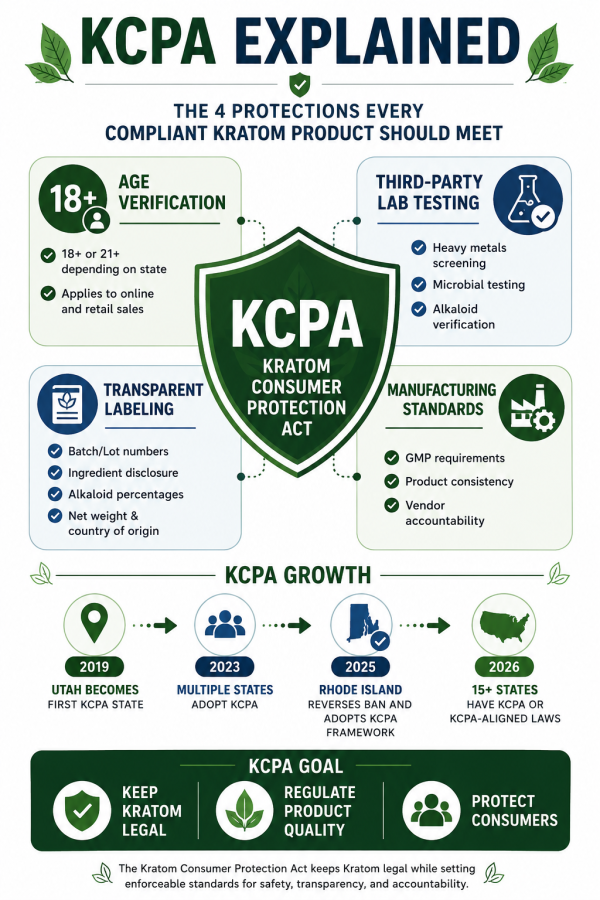
The Kratom Consumer Protection Act (KCPA) is state-level model legislation that keeps Kratom legal while holding vendors to enforceable product standards, covering age verification, lab testing, labeling, and a ban on adulterated products.
It was developed by the American Kratom Association (AKA), a nonprofit advocacy group, as a direct alternative to outright prohibition. Rather than banning Kratom, the KCPA establishes a regulated market with a clear answer to one question: what must a Kratom product meet before it reaches a buyer?
How the KCPA Started: A Timeline of Kratom Regulation
| Year | Milestone |
| 2016 | DEA attempts emergency Schedule I classification of Kratom alkaloids; withdraws after public and scientific pushback |
| 2019 | Utah becomes the first U.S. state to sign the KCPA into law |
| 2021 | Oklahoma becomes the 5th KCPA state |
| 2023 | Virginia and West Virginia both enact the KCPA |
| 2025 | Rhode Island reverses its Kratom ban — the first U.S. state ever to do so — and adopts a KCPA framework |
| 2026 | More than 15 states now have KCPA or KCPA-aligned regulation in place |
KCPA Requirements: Lab Testing, Labeling, Age Verification & GMP
✅ Age Verification (Kratom Age Restriction Law)
- Vendors cannot sell Kratom to anyone under 18 — and most states now require 21+
- Applies to both in-store retail and online sales to residents of KCPA states
- Age gates and point-of-sale verification are mandatory
Read more: How old do you need to be to buy Kratom?
✅ Third-Party Lab Testing
- All products must be tested by an independent, accredited laboratory
- Tests must screen for:
- Heavy metals (lead, arsenic, cadmium, mercury)
- Microbial contamination (Salmonella, E. coli)
- Alkaloid content — specifically mitragynine and 7-hydroxymitragynine (7-OH)
- Results must be publicly accessible upon request and verifiable by buyers
Read more: How to read a Kratom lab test report?
✅ Labeling Requirements
Every KCPA-compliant product label must include:
- Kratom species and country of origin
- Net weight and full ingredient list
- Mitragynine and 7-OH alkaloid concentration (by percentage)
- Batch or lot number
- Expiration or "best by" date
This enables batch-level traceability; if a problem arises, regulators and buyers can identify the exact product run.
Read more: How does product labeling work in the Kratom industry?
✅ Prohibition on Adulterated Products
The KCPA explicitly bans:
- Products containing synthetic Kratom alkaloids
- Products with more than 2% of 7-hydroxymitragynine (naturally occurring 7-OH in Kratom leaf is well below this; synthetic 7-OH products spike this number artificially)
- Kratom mixed with substances scheduled under state law
- Any product with additives that could injure a buyer
✅ Good Manufacturing Practices (GMP)
- Many KCPA versions require manufacturers to follow GMP standards — standardized protocols for facility cleanliness, equipment calibration, batch consistency, and labeling accuracy
- This mirrors the AKA's voluntary GMP certification program, but makes it legally enforceable
Read more: What are Kratom GMP regulations?
Bottom line: Think of the KCPA as a minimum guarantee. Vendors can go further — but in a KCPA
state, they can't do less.
Kratom Regulation by State: Which States Have Passed the KCPA?
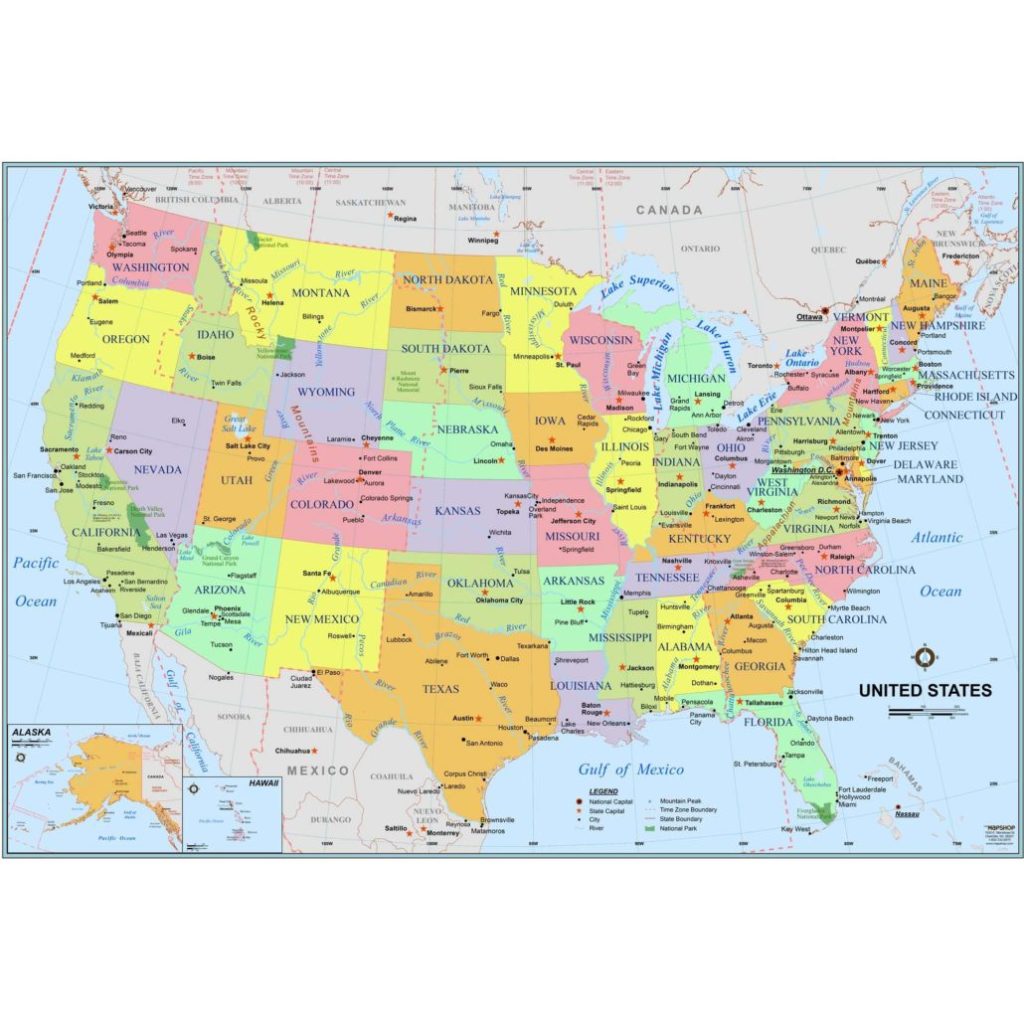
As of mid-2026, more than 15 states have enacted the Kratom Consumer Protection Act or KCPA-aligned legislation, including several of the most populous states in the country.
Confirmed KCPA States (June 2026)
| State | Age Minimum | Notable Details |
| Arizona | 18+ | Limits 7-OH to under 2% |
| Colorado | 21+ | Local bans exist in Denver and some municipalities |
| Florida | 21+ | Synthetic 7-OH was separately banned statewide |
| Georgia | 18+ | Original 2019 adopter; repeal attempt active in 2026 |
| Kentucky | 21+ | KCPA enacted |
| Maryland | 21+ | KCPA-style protections in place |
| Mississippi | 21+ | KCPA enacted |
| Nevada | 18+ | KCPA enacted |
| New York | 21+ | KCPA enacted; labeling rollout ongoing in 2026 |
| Oklahoma | 18+ | The 5th state to pass the KCPA |
| Oregon | 21+ | KCPA enacted |
| Rhode Island | 21+ | Ban reversed; KCPA framework active April 1, 2026 |
| South Carolina | 21+ | KCPA signed May 2025 |
| Texas | 21+ | KCPA passed 2023; alkaloid restriction bill in the Senate |
| Utah | 18+ | First KCPA state (2019) |
| Virginia | 21+ | KCPA was enacted in March 2023 |
| West Virginia | 21+ | KCPA was enacted in March 2023 |
States with pending KCPA bills (as of June 2026): New Hampshire, Kansas, North Dakota, and others. This landscape changes frequently, so it is important to always check current state-level tracking for the latest status.
States Where Kratom Is Banned
The KCPA only applies where Kratom is legal. Current ban states as of mid-2026:
- Alabama — banned since 2016
- Arkansas — banned since 2016
- Indiana — banned since 2014
- Louisiana — banned August 2025
- Vermont — banned since 2016
- Wisconsin — banned since 2014
- Tennessee — ban enacted; restrictions take effect July 1, 2026
Why the KCPA Exists: The FDA Regulation Gap
A fair question is why this is happening at the state level at all — shouldn't the FDA be handling Kratom regulation?
Here's the short answer:
- The FDA has not approved any Kratom product
- The FDA has issued advisories against Kratom, but has not classified it as a controlled substance
- This creates a legal grey area: Kratom is federally legal, but there are no federal product standards
What the AKA did instead:
Instead of waiting for federal action, the AKA developed the KCPA as a state-by-state solution, using existing state commerce and public health frameworks to hold vendors to enforceable standards.
The DEA factor:
In 2016, the DEA attempted an emergency Schedule I classification of Kratom's primary alkaloids. After significant public and scientific opposition, the agency withdrew the proposal. That withdrawal confirmed federal prohibition wasn't imminent — and accelerated advocacy for state-level regulation as the more realistic path forward.
The result: A federally legal product, regulated entirely at the state level, with the KCPA as the dominant framework.
KCPA vs Unregulated Kratom Markets: What Changes for Buyers
The practical difference the KCPA makes is significant.
In a KCPA State
| What the law requires | What it means for you |
| Third-party lab testing | You can verify what's in the product |
| Alkaloid disclosure on the label | You know the Mitragynine and 7-OH percentage |
| Age verification (18+ or 21+) | Kratom legal protection extends to age-gating |
| Ban on synthetic products | No artificially enhanced products on shelves |
| GMP manufacturing standards | Consistent batch quality is legally required |
| Civil and criminal penalties for violations | Vendors are actually accountable |
In a State Without KCPA
- Lab testing is voluntary — no requirement to publish results
- Labeling disclosures are inconsistently enforced
- No state minimum age (unless a local ordinance applies)
- Synthetic or high-7-OH products can be sold freely
- No mandatory penalties for mislabeled or contaminated products
The KCPA’s Role In Preventing Future Kratom Bans
One trend has become clear in states that have considered banning Kratom: concerns about product quality are often at the center of the debate.
The KCPA response: By establishing age restrictions, lab testing mandates, and contamination controls, the KCPA directly addresses those concerns, making it significantly harder to sustain the case for an outright ban.
The proof: Rhode Island banned Kratom in 2017. After years of advocacy, the state reversed the ban in 2025 by signing the Rhode Island Kratom Act, which includes a KCPA-style regulatory framework effective April 1, 2026. It became the first U.S. state ever to reverse a prior Kratom ban. Regulation was the path back to legal access.
As of 2026, the same argument is being made in states such as Georgia and South Carolina, where repeal attempts are underway. Whether the KCPA applies in those states will depend in part on how well the industry demonstrates compliance.
Frequently Asked Questions About the KCPA
1. What does KCPA stand for?
KCPA stands for Kratom Consumer Protection Act. It is a model legislation developed by the American Kratom Association to regulate Kratom at the state level without banning it.
2. Is the KCPA a federal law?
No. The KCPA is state-level legislation. There is no federal equivalent. Each state that has adopted it has passed its own version, which may vary in minimum ages, alkaloid limits, and enforcement mechanisms.
3. How many states have passed the Kratom Consumer Protection Act?
As of mid-2026, more than 15 states have enacted the KCPA or KCPA-aligned regulation. Several more have active bills advancing through their legislatures.
4. What is the Kratom age restriction law under the KCPA?
Most KCPA states set the minimum purchase age at 21. Early-adopting states like Arizona, Nevada, and Utah set it at 18. The kratom age restriction law applies to both in-store and online purchases.
5. Does the KCPA apply to online purchases?
KCPA requirements generally apply based on where a vendor operates and ships from. Compliant vendors apply regulated-state rules to all applicable orders, regardless of the buyer's location.
6. What's the difference between the KCPA and the AKA GMP program?
The AKA's GMP program is voluntary; vendors pay a fee and pass third-party audits to earn certification. The KCPA is a codified state law that is legally enforceable. Many KCPA states incorporate GMP-level standards into the law itself.
7. What happens to vendors who don't comply with the KCPA?
Non-compliant vendors face civil penalties and potentially criminal charges. Severity varies by state, but violations are not treated as minor infractions — fines can be substantial, and repeat offenses may result in loss of license.
Read more: A List Of AKA-Approved Vendors
8. Do all KCPA states follow the same rules?
No. Each state passes its own version of the Kratom Consumer Protection Act, so age limits, labeling rules, licensing requirements, and penalties may differ by state.
9. Does the KCPA make Kratom FDA-approved?
No. The KCPA is state-level legislation. It creates state product standards, but it does not mean Kratom has been approved by the FDA.
10. Which states still ban Kratom entirely?
As of mid-2026: Alabama, Arkansas, Indiana, Louisiana, Vermont, and Wisconsin. Tennessee’s ban was enacted, with the restrictions taking effect July 1, 2026. This list changes, so verify the current status before purchasing or traveling with Kratom products.
Read more: Is Kratom Legal In The US?
Disclaimer: This article is provided for informational purposes only and should not be considered legal, medical, or regulatory advice. Kratom laws and KCPA requirements can change over time and may differ by state. Always verify current regulations in your jurisdiction before purchasing, possessing, or traveling with Kratom products.

 Is Kratom Legal In Connecticut?
 Is Kratom Legal In Delaware?