
If you’re searching “is Kratom legal in Ohio,” the short answer is: it depends on what kind you’re talking about.
Ohio has drawn a clear legal line between two very different things — natural Kratom and synthetic Kratom. As of June 2026, those two categories are treated completely differently under state law. One is permanently banned and classified as a Schedule I controlled substance. The other remains legal under current guidance when sold as raw botanical vegetation.
Before you buy anything, here’s exactly where Ohio stands with no outdated information.
Table Of Contents:
- Ohio Kratom Laws at a Glance
- Is Kratom Legal In Ohio? Current Status (2026)
- Ohio Kratom Legislative History
- The Ongoing Regulatory Battle
- Pending Bills: What the Ohio KCPA Bill and Other Legislation Could Mean
- Can You Buy Kratom Online in Ohio?
- FAQs
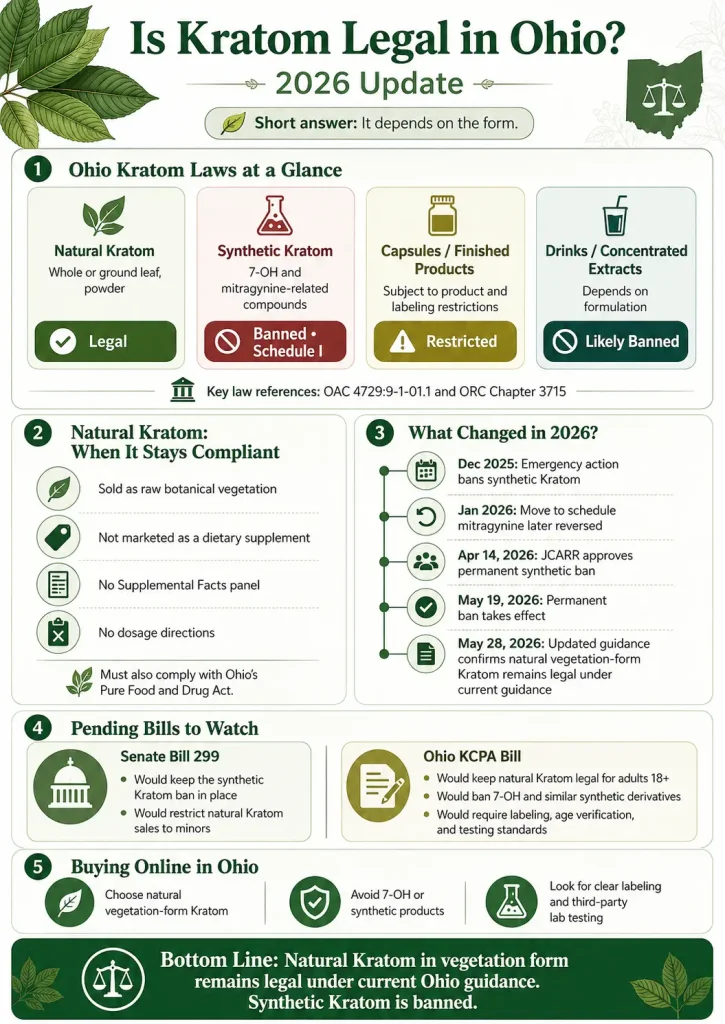
Ohio Kratom Laws at a Glance
| Type of Kratom | Legal Status in Ohio | Governing Law |
| Natural Kratom (whole/ground leaf, powder) | ✅ Legal | OAC 4729:9-1-01.1 (eff. May 19, 2026) |
| Synthetic Kratom (7-OH, mitragynine-related compounds) | ❌ Illegal — Schedule I | OAC 4729:9-1-01.1 (eff. May 19, 2026) |
| Kratom capsules / finished edible products | ⚠️ Restricted — must comply with Pure Food and Drug Act (ORC Chapter 3715) | ORC Chapter 3715 |
| Kratom drinks, extracts with concentrated alkaloids | ❌ Likely banned depending on formulation | OAC 4729:9-1-01.1 |
Note: Natural Kratom powder sold as raw botanical vegetation is legal in Ohio. Anything synthetically derived, concentrated, or sold with supplement-style labeling faces significant legal restrictions or an outright ban.
Is Kratom Legal In Ohio? Current Status (2026)
Natural Kratom: Legal
The Ohio Board of Pharmacy’s official guidance (revised May 28, 2026) makes clear that natural kratom in vegetation form — meaning whole or ground dried leaf — is legal to sell and possess in Ohio under OAC 4729:9-1-01.1.
However, “legal” doesn’t mean “no rules apply.” For natural Kratom to remain on the right side of Ohio law, it must:
- Be sold as raw botanical vegetation — not as a dietary supplement or finished product
- Have no “Supplemental Facts” panel on the label
- Include no guidelines or directions instructing ingestion
- Comply fully with Ohio’s Pure Food and Drug Act (ORC Chapter 3715)
The Board of Pharmacy explicitly notes that retailers must contact the Ohio Department of Agriculture’s Division of Food (614-728-6250) for compliance guidance.
Synthetic Kratom: Permanently Banned
Synthetic Kratom — including 7-Hydroxymitragynine (7-OH), Mitragynine Pseudoindoxyl, Dihydro-7-Hydroxymitragynine, and 7-Acetoxymitragynine — is now a permanent Schedule I controlled substance in Ohio.
The permanent ban, established under OAC 4729:9-1-01.1, took effect on May 19, 2026, replacing the temporary executive order that Gov. Mike DeWine had signed in December 2025. The rule was finalized by the Joint Committee on Agency Rule Review (JCARR) following a legislative review process.
What this means:
- Synthetic Kratom products (often sold as 7-OH shots, tablets, or edibles at gas stations and vape shops) are now illegal to sell, possess, or distribute in Ohio
- Retailers who stocked these products were required to dispose of them immediately
- Violations carry felony-level consequences under Schedule I drug statutes
Ohio Kratom Legislative History
Ohio’s Kratom situation didn’t happen overnight. Here’s a quick timeline of how state law evolved:
| Date | Event |
| 2019–2024 | The Ohio DOH links Kratom to more than 200 unintentional overdose deaths |
| Oct. 2025 | Ohio lawmakers introduce legislation to ban synthetic Kratom and restrict natural Kratom sales |
| Dec. 2025 | Gov. DeWine signs executive order, immediately banning synthetic Kratom; Ohio Board of Pharmacy enacts emergency rule (eff. Dec. 12, 2025) |
| Jan. 2026 | The Ohio Board of Pharmacy approves additional rules to classify natural Kratom’s primary alkaloid (mitragynine) as a Schedule I drug — later reversed |
| Mar.–Apr. 2026 | JCARR hearings held; public testimony on both sides of the debate |
| Apr. 14, 2026 | JCARR approves permanent ban on synthetic Kratom; effective date set for May 14, 2026 |
| May 19, 2026 | Permanent ban on synthetic Kratom formally in effect under OAC 4729:9-1-01.1; Ohio Board of Pharmacy issues revised consumer and retailer guidance |
| May 28, 2026 | The Ohio Board of Pharmacy publishes final updated FAQ confirming natural Kratom powder remains legal |
Important: In January 2026, the Board of Pharmacy had moved to also ban natural Kratom by scheduling mitragynine itself. That push did not advance to a permanent rule, meaning natural leaf Kratom powder retained its legal standing. However, the Board has stated it is still considering the question.
The Ongoing Regulatory Battle
Ohio is arguably the most active Kratom battleground in the country right now. Three forces are keeping the situation fluid:
- Governor’s push: Gov. DeWine has consistently called for a complete ban on all forms of Kratom, citing data linking the plant to more than 200 accidental overdose deaths between 2019 and 2024.
- Active litigation: The Ohio Board of Pharmacy faces ongoing legal challenges — including a court-issued temporary restraining order over whether natural Kratom mixed into a beverage counts as a banned product.
- Legislative divide: Lawmakers are split between a total ban on all Kratom and a regulation-first approach through the Kratom Consumer Protection Act framework.
Check the legal status of Kratom in other areas of the United States in this blog: “Is Kratom Legal?”
Pending Bills: What the Ohio KCPA Bill and Other Legislation Could Mean
If you’re following Ohio Kratom laws, these are the active legislative items to watch:
Senate Bill 299
- Introduced: 2025
- Status: In Senate General Government Committee as of March 2026
- Key provisions of SB299: Permanent ban on synthetic Kratom; restricts natural Kratom sales to minors
Kratom Consumer Protection Act (Ohio KCPA Bill)
- Introduced: November 2025 (Rep. Odioso / Rep. Lorenz)
- Status: In House committee
- Key provisions:
- Keeps natural Kratom legal for adults 18+
- Bans 7-OH and other synthetic derivatives
- Requires accurate labeling and age verification
- Establishes product testing standards
Why it matters: If the Ohio KCPA bill passes, it would formalize protections for natural Kratom vendors and buyers, moving Ohio from a grey-area regulatory environment to a clear, consumer-protection framework similar to states like Nevada, Utah, and Arizona that have already enacted KCPA legislation.
If a full ban passes, Ohio would join a small group of states where Kratom is fully prohibited, making online purchasing from out-of-state vendors a legally complicated proposition.
Ohio residents have also been weighing in on the policy review directly — see the ongoing community discussion here.
Can You Buy Kratom Online in Ohio?
Yes, Ohio residents can legally purchase natural Kratom powder online, provided:
- The product is natural Kratom in vegetation/powder form (not synthetic, not 7-OH-based)
- The vendor complies with Ohio’s labeling restrictions (no supplement panel, no directions)
- The vendor ships in compliance with applicable laws
Why Buying Online Can Be a Smarter Choice
Gas stations and convenience stores have been ground zero for synthetic Kratom products in Ohio. The state’s enforcement actions have specifically targeted that retail channel. When you buy from a dedicated online Kratom vendor:
- Products are more likely to be clearly labeled as raw botanical material
- Reputable vendors typically conduct third-party lab testing
- You can verify the product is natural Kratom leaf powder — not a synthetic compound sold in lookalike packaging
FAQs
1. Is Kratom legal in Ohio in 2026?
Natural Kratom sold in its vegetation form, such as raw powder or ground dried leaf, may still be legally sold in Ohio when it meets Ohio’s current requirements.
Synthetic Kratom — including 7-OH and related compounds — is permanently banned as a Schedule I controlled substance under OAC 4729:9-1-01.1 (effective May 19, 2026).
2. What is the criminal penalty for synthetic Kratom in Ohio?
Synthetic Kratom compounds are Schedule I controlled substances in Ohio. Possession, sale, or distribution can result in felony-level charges under Ohio’s drug statutes.
3. Are Kratom capsules legal in Ohio?
Kratom capsules are not explicitly banned, but they face significant legal hurdles. Ohio’s Pure Food and Drug Act (ORC Chapter 3715) creates restrictions on finished Kratom products.
4. Could Ohio ban natural Kratom in the future?
Possibly. The Ohio Board of Pharmacy has stated it is still considering extending the ban to natural Kratom. Governor DeWine has publicly advocated for a complete ban.
5. Is it legal to travel through Ohio with Kratom?
Under current guidance, natural Kratom in vegetation form is treated differently from banned synthetic Kratom products, but travelers should check the latest Ohio guidance before carrying Kratom into or through the state.
Read more: Can you fly with Kratom on a plane?
Disclaimer:
Information in this article reflects publicly available guidance from the Ohio Board of Pharmacy (OAC 4729:9-1-01.1, revised May 28, 2026) and reporting from the Ohio Statehouse News Bureau and Kent State NewsLab. This article is for informational purposes only and does not constitute legal advice. Consult a licensed Ohio attorney for legal guidance specific to your situation.

 Is Kratom Legal in Georgia? Complete 2026 Legal Overview
 Is Kratom Legal In California? The 2026 Update