You’ve probably come across dozens of Kratom strains by now — Red Bali, Green Maeng Da, White Borneo. They’re all processed the same way: harvest, dry, grind.
Bentuangie (Been-Two-Ann-Gee) Kratom doesn’t play by those rules.
This is the one strain in the entire Kratom catalog that skips the drying line and goes through something entirely different, a controlled fermentation process that chemically transforms the leaf before it ever becomes powder.
The result is a darker product, a shifted alkaloid profile, and a strain that has earned nicknames like Chocolate Kratom and Royal Kratom long before most people knew it existed.
If you’re new to Bentuangie — or you’ve heard about it but want the full picture — this guide covers everything: the science, the history, the varieties, what that dark powder actually means, and where to find it.
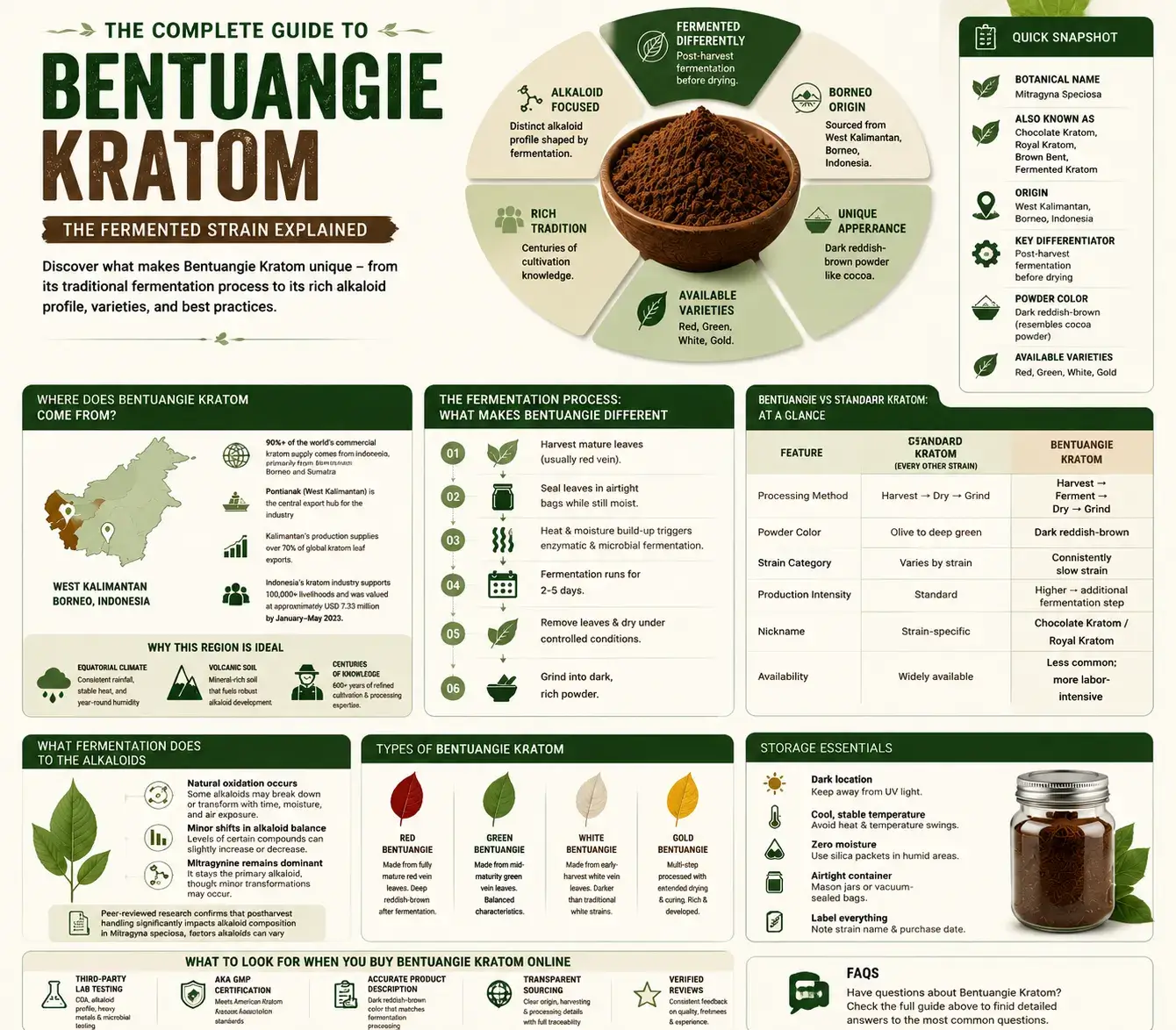
Table Of Contents:
- Quick Snapshot: What Is Bentuangie Kratom?
- Where Does Bentuangie Kratom Come From?
- The Fermentation Science: What Actually Makes Bentuangie Different
- Why Is It Called “Chocolate Kratom”?
- Types Of Bentuangie Kratom
- How To Store Bentuangie Kratom?
- What To Look For When You Buy Bentuangie Kratom Online?
- FAQs About Bentuangie Kratom
Quick Snapshot: What Is Bentuangie Kratom?
| Botanical name | Mitragyna Speciosa |
| Also known as | Chocolate Kratom, Royal Kratom, Brown Bent, Fermented Kratom |
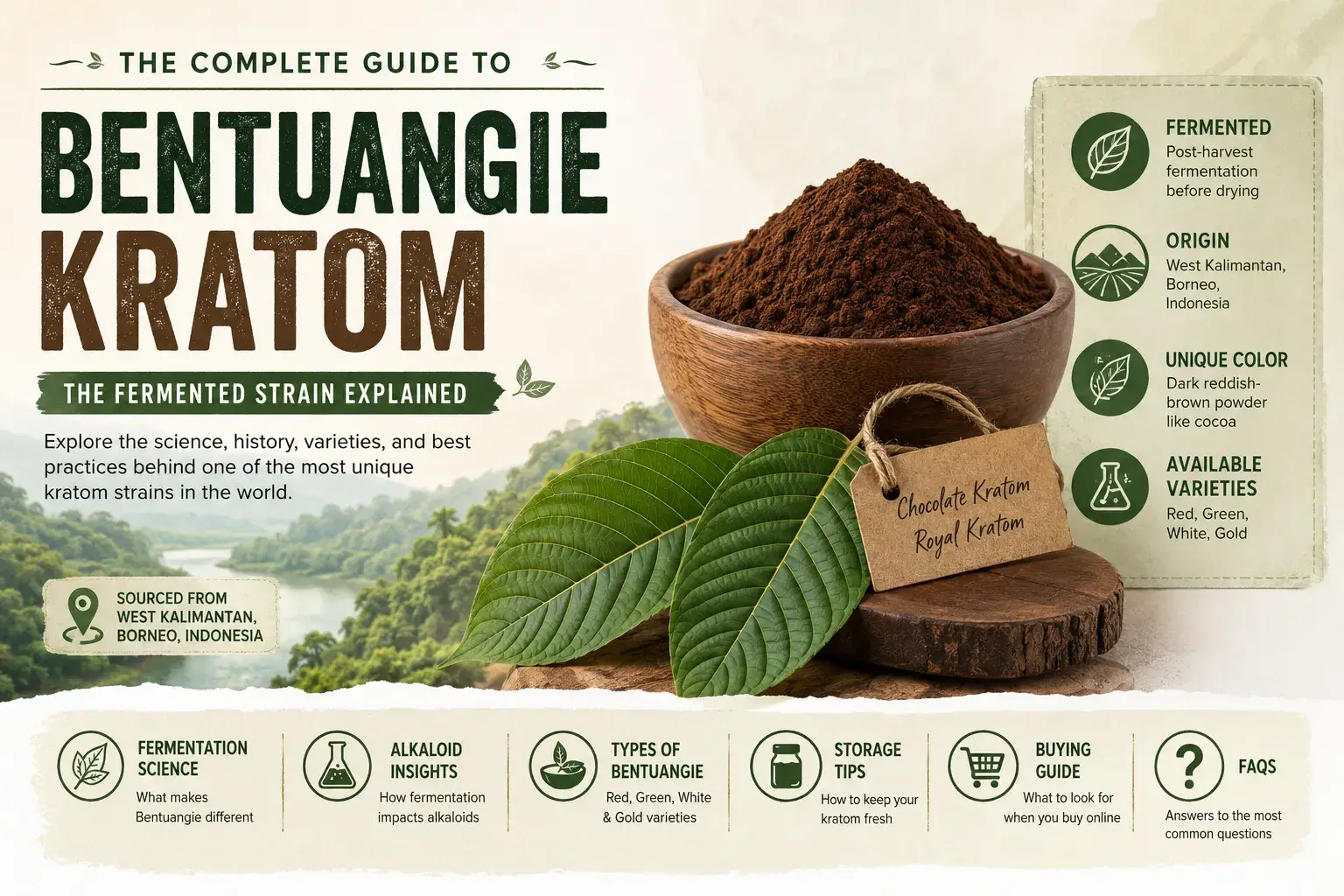
| Origin | West Kalimantan, Borneo, Indonesia |
| Key differentiator | Post-harvest fermentation before drying |
| Powder color | Dark reddish-brown (resembles cocoa powder) |
| Available varieties | Red, Green, White, Gold |
Where Does Bentuangie Kratom Come From?
Bentuangie Kratom traces its roots to West Kalimantan — the Indonesian portion of the island of Borneo — one of the most fertile Kratom-growing regions on the planet.
Indonesia dominates the global Kratom trade for a reason:
- 90%+ of the world’s commercial Kratom supply comes from Indonesia, primarily from Borneo and Sumatra
- The port city of Pontianak (West Kalimantan) serves as the central export hub for the industry
- Kalimantan’s production volume alone is estimated to supply over 70% of global Kratom leaf exports
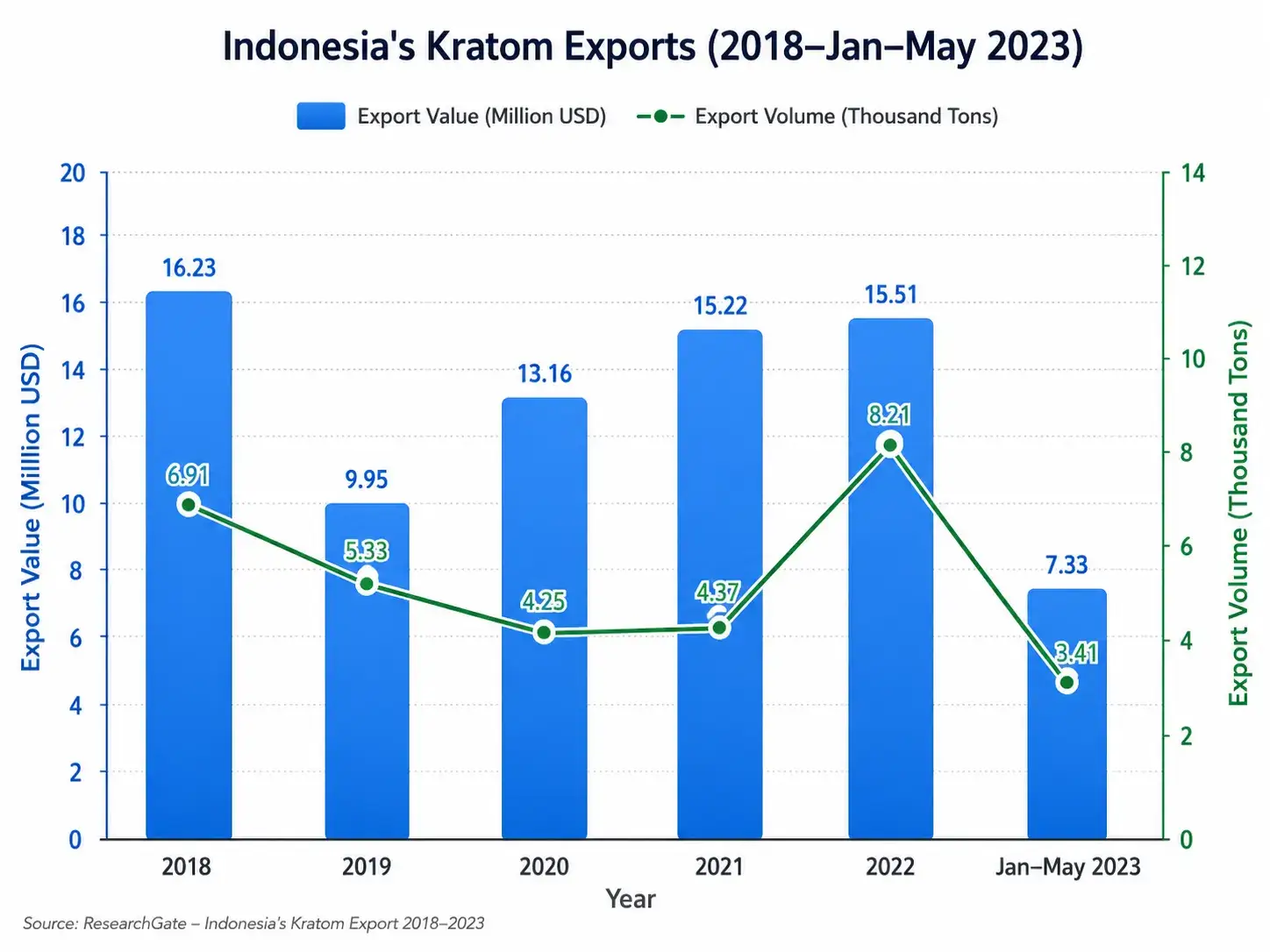
- Indonesia’s Kratom industry supports more than 100,000 livelihoods, with the sector valued at approximately USD 7.33 million by January-May 2023.
Why does this region produce such exceptional Kratom?
🌿 Equatorial climate — consistent rainfall, stable heat, and year-round humidity
🌋 Volcanic, mineral-rich soil — dense in the nutrients that drive robust alkaloid development in Mitragyna speciosa leaves
🧑🌾 600+ years of cultivation knowledge — Indonesian farmers have refined harvest timing, fermentation technique, and processing conditions across generations
Bentuangie specifically thrives here because the same warm, humid conditions that support exceptional leaf growth also provide the ideal environment for the fermentation step that defines the strain.
The Fermentation Science: What Actually Makes Bentuangie Different
Bentuangie Kratom is defined by what happens after harvest rather than the leaf itself. Instead of going straight into drying, the leaves are sealed while still moist, allowing natural fermentation to begin. This controlled process is what sets Bentuangie apart from standard Kratom processing methods.
Standard Kratom (every other strain):
- Leaves harvested at the target maturity stage
- Stems removed
- Leaves dried — sun, shade, or UV light (determines vein color classification)
- Dried leaves ground into powder
Bentuangie Kratom:
- Leaves harvested at target maturity (usually red, fully mature leaves)
- Packed immediately into sealed plastic bags or airtight containers while still holding natural moisture
- Bags trap heat and moisture → enzymatic and microbial fermentation begins
- Fermentation runs for 2–5 days, depending on conditions and producer protocol
- Fermented leaves removed, dried under controlled conditions
- Ground into the finished dark powder
Bentuangie vs Standard Kratom: At a Glance
| Feature | Standard Kratom Strains | Bentuangie Kratom |
| Processing method | Harvest → Dry → Grind | Harvest → Ferment → Dry → Grind |
| Powder color | Olive to deep green | Dark reddish-brown |
| Strain category | Varies by strain | Consistently slow strain |
| Production intensity | Standard | Higher — additional fermentation step |
| Nickname | Strain-specific | Chocolate Kratom / Royal Kratom |
| Availability | Widely available | Less common; more labor-intensive |
What Fermentation Does to the Alkaloids
Mitragyna Speciosa leaves naturally contain a complex matrix of alkaloids. The primary compound, Mitragynine, typically accounts for 60–70% of the total alkaloid content in standard Kratom. Other key alkaloids include 7-Hydroxymitragynine, Speciogynine, and Paynantheine.
When leaves undergo fermentation or extended moisture-controlled curing, chemical conditions within the plant material begin to shift. This process is not fully standardized across the industry, and the exact changes can vary depending on time, temperature, humidity, and technique.
Alkaloid changes during processing
- Natural oxidation occurs: Some alkaloids may slowly break down or transform when exposed to air, moisture, and time.
- Minor shifts in alkaloid balance: Levels of certain compounds can increase or decrease slightly depending on processing conditions.
- Mitragynine remains the dominant alkaloid: although minor transformations may occur, it generally remains the primary compound present.
Peer-reviewed research confirms that postharvest handling has a significant and measurable impact on alkaloid composition in Mitragyna speciosa, including that withering alone can increase mitragynine concentrations by 14–65% depending on cultivar and conditions. Fermentation, which is considered a far more intensive intervention, produces even more dramatic shifts.
Why Is It Called “Chocolate Kratom”?
The nickname is entirely about visual traits and not about the flavor of your favorite Chocolate.
When Bentuangie leaves undergo fermentation, the cellular breakdown process degrades chlorophyll and triggers oxidation of the leaf’s natural pigments. The result is a powder that is noticeably, unmistakably darker than any conventional Kratom:
- Standard Kratom powder → light sage green to deep olive green
- Bentuangie / Chocolate Kratom Powder → deep reddish-brown, resembling cocoa or dark chocolate powder
This dark brown Bentuangie Kratom color is your most immediate quality signal when evaluating a product. It’s the visible footprint of the fermentation process — the same reason oxidized tea leaves turn black, or cacao ferments from a pale nib to a deep chocolate brown.
Types Of Bentuangie Kratom
Bentuangie comes in multiple varieties. The fermentation process remains the same; what changes is the maturity of the selected leaf. This has a great impact on the final alkaloid composition.
🔴 Red Bentuangie Kratom
The most widely recognized Bentuangie variation is made using fully mature leaves. It is the most commonly produced starting point for fermented Kratom.
- Starts with red-veined leaves selected at peak maturity
- Develops a deep reddish-brown color after fermentation and drying
- Fermentation influences the overall alkaloid balance through natural enzymatic and moisture-driven processes
➡️ Shop Red Bentuangie Kratom Powder at Oasis Kratom!
🟢 Green Bentuangie Kratom
Green Bentuangie is made from mid-maturity green-veined leaves before fermentation begins.
- Fermentation shifts the natural profile of the raw leaf through controlled moisture and heat conditions
- Produces a darker, more muted green-to-brown final powder compared to standard green Kratom
- Often described as a middle ground compared to its non-fermented counterpart
➡️ Browse From Our Green Kratom Collection!
⚪ White Bentuangie Kratom
White Bentuangie begins with early-harvest white-veined leaves and follows the same fermentation process used for all Bentuangie types.
- Undergoes fermentation, where moisture and time influence natural enzymatic activity in the plant material
- The finished product typically appears darker than traditional White Kratom Powders due to oxidation and curing
- Often produced in smaller batches due to the more controlled processing conditions required during the fermentation stage
➡️ Shop From Our White Kratom Collection!
🟡 Gold Bentuangie Kratom
Gold Bentuangie is a multi-step-processed variation that builds on fermentation, with additional drying and curing stages.
- Combines fermentation with extended or multi-stage drying methods
- Additional curing steps further influence alkaloid stability and overall composition
- Produces a darker, more developed powder compared to single-process Bentuangie types
- Requires careful moisture control to avoid over-fermentation during processing
➡️ Check Gold Kratom Powder Collection at Oasis Kratom!
How To Store Bentuangie Kratom?
Storage matters for all Kratom, but Bentuangie warrants a bit of extra attention. The alkaloid profile that fermentation creates, particularly the elevated alkaloid concentrations, is more susceptible to oxidative degradation than a standard Kratom powder if conditions aren’t right.
Storage essentials:
🌑 Dark location: UV light degrades Kratom alkaloids; a pantry, closet, or cabinet works well
🌡️ Stable, cool temperature: avoid heat sources, appliances, or rooms with temperature swings
💧 Zero moisture: humidity is the primary enemy; add silica desiccant packets if you’re in a humid climate
🔒 Airtight container: mason jars or vacuum-sealed bags outperform original packaging for long-term freshness
🏷️ Label everything: note purchase date, seal date, and strain name for easy tracking
Well-stored Bentuangie maintains quality for several months. Poorly stored Bentuangie can degrade noticeably within weeks.
Learn more about where and how to store Kratom properly for a longer shelf life.
What To Look For When You Buy Bentuangie Kratom Online?
Bentuangie requires additional processing steps compared to standard Kratom, which can also lead to wider variation in product quality. Because of this, checking authenticity, sourcing, and testing information becomes especially important before purchasing.
🧪 Third-Party Lab Testing
- COA from an independent laboratory
- Alkaloid profile included (mitragynine & 7-OH)
- Heavy metals screening completed
- Microbial testing included
- COA available on product page or upon request
Know how to read a Kratom lab test report easily.
🏅 AKA GMP Certification
- Certified under American Kratom Association GMP standards
- Third-party audited facility compliance
- Packaging and labeling standards verified
- Recognized industry quality benchmark
Check the list of American Kratom Association-approved vendors.
🌿 Accurate Product Description
- Dark reddish-brown or chocolate-brown color
- Matches fermentation-based processing
- Product images reflect the actual powder color
🌍 Transparent Sourcing
- Clear regional origin (e.g., West Kalimantan / Borneo)
- Harvesting and processing details provided
- No vague or generic sourcing claims
- Strong traceability from origin to final product
Learn how to grow Kratom sustainably.
⭐ Verified Customer Reviews
- Verified purchaser feedback
- Consistency across batches
- Product matches description upon arrival
- Packaging and freshness are noted in reviews
Check the reviews for Oasis Kratom here.
FAQs About Bentuangie Kratom
1.What is fermented Kratom?
Fermented Kratom refers to Mitragyna speciosa leaves that are sealed in airtight conditions immediately after harvest, allowing natural enzymatic and microbial activity to occur before drying. This alters alkaloid composition. Bentuangie is by far the most well-known example of fermented Kratom on the market.
Read about Fermented Kratom in detail.
2.How long is Bentuangie Kratom fermented?
The fermentation period typically lasts 2–5 days, though the exact duration varies with ambient temperature and humidity, the starting moisture content of the leaves, and the producer’s specific processing protocol.
3.Where does Bentuangie Kratom come from?
Bentuangie Kratom is primarily sourced from West Kalimantan (Borneo), Indonesia — the region responsible for the majority of the world’s commercial Kratom supply. Indonesia accounts for over 90% of global Kratom exports, and Borneo’s equatorial climate, high humidity, and volcanic soils provide ideal conditions for Mitragyna Speciosa cultivation.
4.Is Bentuangie Kratom stronger than regular Kratom?
Not inherently. Bentuangie Kratom is processed differently through fermentation, which may alter its overall alkaloid profile compared to standard Kratom strains.
However, there is no universal scientific standard showing that Bentuangie is consistently stronger than non-fermented Kratom, since potency can vary between batches, sourcing regions, and processing methods.
Check the Kratom strain chart for more information.
5.What does dark brown Bentuangie Kratom powder look like?
Standard Kratom ranges from sage green to deep olive. Bentuangie is a rich, deep reddish-brown — closer to cocoa powder than anything in the conventional Kratom range. Green-looking “Bentuangie” powder signals incomplete fermentation or mislabeling.
6.Is there a difference between Chocolate Bentuangie and Chocolate Kratom Powder?
No — same product, different names. All three terms (“Chocolate Kratom Powder,” “Chocolate Bentuangie,” “Bentuangie Kratom”) refer to the same fermented Mitragyna speciosa powder. The chocolate reference is purely about color.
7.Does Bentuangie Kratom expire faster than regular Kratom?
No. Bentuangie Kratom generally has a shelf life similar to other Kratom powders, typically around 6–12 months when stored properly in a cool, dry, airtight environment.
Learn about the shelf life of Kratom here.
Disclaimer: These statements have not been evaluated by the Food and Drug Administration. This product is not intended to diagnose, treat, cure, or prevent any disease. Must be 21 years of age or older to purchase. Keep out of reach of children. Not for pregnant or nursing women.

 Kratom Trading Company Vendor Review
 Krave Kratom Vendor Review