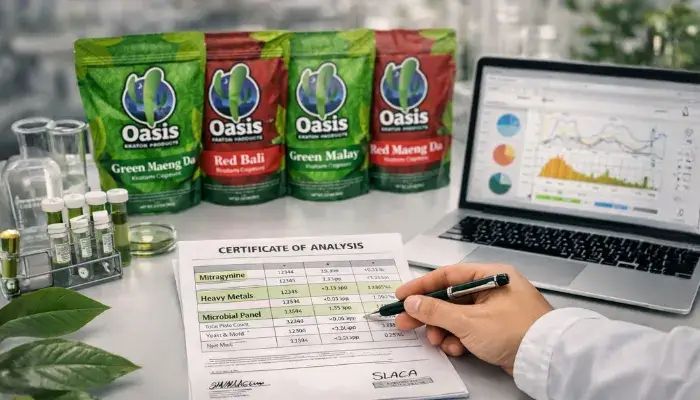
You click on a Kratom vendor's "Lab Tested" badge. A PDF opens. You see rows of numbers, scientific abbreviations, and words like "CFU/g" and "ICP-MS." You close it. Sound familiar?
Most Kratom buyers skip the COA because it looks confusing. But here's the thing — once you know what each section means, a COA takes less than two minutes to read. And those two minutes tell you more about what's actually in your Kratom than any product description ever will.
This guide walks through every section of a real Kratom Certificate of Analysis step by step, and provides a full mock COA walkthrough with real numbers. By the end, you'll know exactly what to look for — and what should make you walk away.
What Is A Kratom Certificate Of Analysis (COA)?
A Certificate of Analysis — or COA — is a document from an independent testing lab that shows what's in a specific batch of Kratom. It covers things like how much of the active alkaloids are present, whether any harmful bacteria were found, and whether heavy metals are within the optimal limits.
Think of it as a nutrition label, but one created by a scientist with no connection to the company selling the product. That independence is what makes it trustworthy.
| 📋 QUICK DEFINITION: COA vs. Lab Report |
| These two terms mean the same thing. A Certificate of Analysis (COA) is the formal name. "Lab report" or "lab results" are informal terms for the same document. |
| The important word is third-party — the lab that creates the COA should be a separate, accredited company with no financial connection to the Kratom vendor. |
| In-house testing (where a vendor tests their own products) is not the same thing and carries far less weight. |
Every real COA is tied to a specific batch number. That batch number should match the number printed on your product packaging. If it doesn't — or if there's no batch number at all — the results you're looking at may not apply to the product in your hands.
Why Does This Matter So Much for Kratom?
Kratom isn't regulated the way prescription drugs or even most food supplements are. The FDA doesn't require pre-market testing, so the quality of what you buy depends entirely on how seriously the vendor takes testing on their own. Vendors who make their COAs publicly available are essentially saying: "Don't trust us — verify us." That level of transparency sets a clear standard and gives you something concrete to evaluate before you buy.
The American Kratom Association (AKA) requires third-party lab testing as a core part of its GMP accreditation program. AKA-accredited vendors like Oasis Kratom must test every batch and keep records, which is one of the strongest signals that a vendor is legitimate.
Kratom COA Explained: What Each Section Covers
A full Kratom COA has four core sections plus some optional ones. Here's a quick glance before we go deep on each:
| Section | What It Tests | Testing Method | Why It Matters |
| Lab & Sample ID | Who tested it, what batch, when | Document verification | Confirms the COA is legitimate and applies to your product |
| Alkaloid Profile | Mitragynine, 7-OH, other alkaloids | HPLC (High-Performance Liquid Chromatography) | Shows potency — tells you how strong the product is |
| Microbial Panel | Bacteria, yeast, and mold | Plate count, PCR methods | Confirms it won't make you sick |
| Heavy Metals | Lead, cadmium, arsenic, mercury | ICP-MS (Inductively Coupled Plasma) | Checks for toxic metals absorbed from the soil |
| Pesticides (optional) | Agricultural chemical residues | LC-MS/MS or GC-MS/MS | Confirms no harmful chemicals from farming |
| Solvents (optional) | Residual processing chemicals | Headspace GC | Important for extracts and concentrated products |
Lab & Sample ID
This is the very first thing you check, even before the numbers. It tells you whether the COA in front of you is worth reading at all.
| 🔬 WHAT TO CHECK: Lab & Sample Info |
| Lab name and accreditation: Look for ISO/IEC 17025 accreditation — the international gold standard for testing labs. The accreditation number should be on the document. You can verify it through the lab's accrediting body. |
| Batch or lot number: Must match the number on your product packaging exactly. This is the link between the test and the product. |
| Test date: Should be within the last 12 months. Kratom alkaloids can degrade over time, and a two-year-old COA doesn't tell you much about your current batch. |
| Sample description: Should describe the actual product form — powder, capsules, extract — and match what you're holding. |
| Lab contact details: A real COA has the lab's address, phone number, and often a report number. Generic-looking documents with no verifiable lab info are a red flag. |
One thing that's easy to miss: some vendors use a single COA for their entire product line, or show the same document for multiple batches. A COA should be batch-specific. If the same document covers all their strains or spans multiple years, that's not proper testing.
Alkaloid Profile
This section of the COA measures the amount of each alkaloid in the batch. It's the potency check.
The two most important ones are Mitragynine and 7-Hydroxymitragynine (7-OH). But better-quality COAs will also measure several others.
| WHAT TO CHECK: Alkaloid Profile |
| Mitragynine: This is the primary alkaloid. In plain leaf powder, a healthy range is 0.5% to 1.5% (reported as % weight by weight). Some premium batches may be slightly above 1.5%. A value below 0.5% suggests an old, degraded, or diluted product. |
| 7-Hydroxymitragynine (7-OH): Naturally present in tiny amounts — usually between 0.01% and 0.04%. A result above 0.1% is unusual and may suggest that synthetic 7-OH was added, which is a serious concern. |
| Paynantheine, Speciogynine, Speciociliatine: These secondary alkaloids confirm the product is genuine Mitragyna speciosa, not a synthetic fake or a substituted plant species. Their presence is a good sign. |
| Total alkaloid content: Some labs report the combined total. A higher total from a full panel indicates a more potent, complex product. |
Note: High-Performance Liquid Chromatography (HPLC) is the most reliable method for measuring alkaloids, separating and quantifying each compound with precision. If a COA lists HPLC or HPLC-UV, it indicates more rigorous testing standards, whereas methods like TLC provide less detailed results.
Why Alkaloid Numbers Don’t Stay the Same
Alkaloid levels are not fixed. They shift naturally between strains, and even between batches of the same strain.
Red Kratom often shows slightly higher 7-OH levels, while White varieties tend to lean higher in mitragynine. Green products usually fall between the two. This variation is normal. It’s also why COAs are tied to specific batches, not just to strain names.
| Kratom Type | Mitragynine Tendency | 7-OH Tendency |
| White | Higher end (1.0–1.5%+) | Very low (0.01–0.03%) |
| Green | Mid-range (0.8–1.3%) | Low-moderate (0.02–0.04%) |
| Red | Moderate (0.7–1.2%) | Slightly higher (0.03–0.06%) |
| 🚩 RED FLAGS: Alkaloid Section |
| Mitragynine below 0.5%: Low-quality or degraded product. |
| 7-OH above 0.1%: Natural Kratom rarely exceeds this. Higher levels suggest synthetic adulteration. |
| Mitragynine above 2% in plain leaf powder: Unusual. Could indicate blending with an extract, which isn't inherently bad but should be disclosed. |
| No alkaloid testing at all: Some COAs only show overall results. That means potency is completely unverified. |
Microbial Panel
Kratom is a plant that grows in tropical environments, gets harvested by hand, dried outdoors, and shipped across the world. At every step, it can pick up bacteria and mold. The microbial panel is the check that confirms none of those made it into your product at dangerous levels.
| 🦠 WHAT TO CHECK: Microbial Panel |
| Salmonella: Must be 'Negative' or 'Not Detected (ND).' There is no acceptable level — any detection is an automatic fail. |
| E. coli (Escherichia coli): Must be 'Negative' or 'ND.' Any presence indicates fecal contamination. |
| Staphylococcus aureus (Staph): Must be 'Negative' or 'ND.' |
| Yeast and Mold (Total): Measured in CFU/g (colony-forming units per gram). The acceptable limit is generally below 100,000 CFU/g. Below 1,000 CFU/g is excellent. |
| Total Aerobic Plate Count (APC): The overall bacterial load. Should be under 100,000 CFU/g for plant material. |
| Coliforms: Acceptable below 10,000 CFU/g. |
| Pseudomonas aeruginosa: Sometimes included. Should be 'Negative' — this organism can cause serious infections in people with weakened immune systems. |
Note: CFU/g stands for Colony Forming Units per gram. It measures the density of living microorganisms in a sample. For pathogens like Salmonella and E. coli, the only acceptable result is zero. For background microbes like yeast and mold, there are threshold limits — small amounts are normal and harmless, but high counts indicate poor handling or storage conditions.
| 🚩 RED FLAGS: Microbial Section |
| Any detection of Salmonella, E. coli, or Staph — automatic disqualifiers with no exceptions. |
| Yeast and mold counts at or above 100,000 CFU/g. |
| No microbial panel at all — this is a standard test, and skipping it is a serious gap. |
| Results listed as 'See attached' with no actual numbers on the COA — vague and unverifiable. |
Heavy Metals Panel
Kratom plants absorb minerals from the soil — and unfortunately, they can also absorb toxic heavy metals if the soil or water supply is contaminated. These metals can accumulate in the body over time, which is why this panel matters even if nothing seems off right away.
The best labs test heavy metals using a method called ICP-MS (Inductively Coupled Plasma Mass Spectrometry). It's extremely sensitive and can detect metals at parts-per-billion levels.
| WHAT TO CHECK: Heavy Metals |
| Lead (Pb): Should be below 1.0 ppm. Typical good result: ND or under 0.5 ppm. |
| Cadmium (Cd): Should be below 0.5 ppm. Cadmium accumulates in the kidneys over years of exposure. |
| Arsenic (As): Should be below 1.0 ppm. Both inorganic arsenic (more toxic) and total arsenic may be reported. |
| Mercury (Hg): Should be below 0.5 ppm. Any detectable mercury is worth flagging. |
| Nickel (Ni): Sometimes included. Should be within published limits. |
| Pass/Fail indicator: Most labs include a simple pass/fail alongside each result. A clear 'PASS' means all metals are within acceptable parameters. |
Results are shown in ppm (parts per million) or ppb (parts per billion). A result of 'ND' (Not Detected) means the metal wasn't found at detectable levels. The reference limits come from FDA action levels for botanical products and AKA GMP guidelines.
| 🚩 RED FLAGS: Heavy Metals Section |
| Any category marked 'FAIL' — do not use the product. |
| Missing heavy metals panel entirely — this is a non-negotiable test for any serious vendor. |
| Results shown without units — 'Lead: 0.3' is meaningless without knowing if that's ppm, ppb, or mg/kg. |
| Only one or two metals tested — the full panel should cover at least lead, cadmium, arsenic, and mercury. |
Pesticides and Residual Solvents
These two panels aren't always included, but the best COAs cover them. Their presence shows a vendor is going beyond the minimum.
Pesticide Residue Testing
Kratom farms, like all farms, may use pesticides during cultivation. A pesticide screen checks whether any of those chemicals made it into the final product. Comprehensive panels screen for 200 to 400+ compounds using LC-MS/MS or GC-MS/MS.
All results should read ND (Not Detected) or fall below established maximum residue limits (MRLs). If specific compounds are detected but listed as below the MRL, that's generally still acceptable — but ND is always preferable.
Residual Solvent Testing
This one matters mainly for Kratom extracts, shots, and concentrated products. These products are often made using chemical solvents during processing. If those solvents aren't fully removed, traces can remain in the final product. All screened solvents should show ND.
| ✅ GOOD SIGN: Pesticide + Solvent Panels Present |
| These panels cost money and take time. A vendor who pays for them, even when not required to, signals they actually care about what's in their product — not just checking boxes. |
| For extracts specifically, always look for residual solvent testing. If it's not there, ask. |
Kratom Certificate of Analysis Abbreviation Glossary: What All Those Terms Actually Mean
Many people skip COAs because of the jargon. Here’s what those common abbreviations actually mean:
| Term | What It Stands For | What It Means |
| COA | Certificate of Analysis | The lab report document itself |
| ND | Not Detected | The lab tested for it and found none — the best result for any contaminant |
| <LOQ | Below Limit of Quantification | Trace amounts present, but too small to measure accurately |
| LOD | Limit of Detection | The smallest amount the test can detect at all |
| CFU/g | Colony Forming Units per gram | How many living microorganisms are in each gram of the sample |
| ppm | Parts per million | A unit of concentration — 1 ppm = 1 mg per kg |
| ppb | Parts per billion | A much smaller unit — 1 ppb = 1 µg per kg |
| % w/w | Percent weight by weight | How much of a substance (like mitragynine) is in the total sample by weight |
| HPLC | High-Performance Liquid Chromatography | The most accurate method for measuring alkaloids |
| ICP-MS | Inductively Coupled Plasma Mass Spectrometry | The most accurate method for detecting heavy metals |
| LC-MS/MS | Liquid Chromatography-Mass Spectrometry | Used for pesticide residue testing |
| GC-MS/MS | Gas Chromatography-Mass Spectrometry | Used for solvents and some pesticide screens |
| APC | Aerobic Plate Count | Total bacterial count — a general indicator of microbial cleanliness |
| ISO/IEC 17025 | International testing lab standard | Accreditation confirming the lab meets rigorous quality standards |
How to Read a Real Kratom COA: A Line-by-Line Walkthrough?
This section uses a real third-party lab report as an example to show what a complete COA looks like and how to read each result correctly. You’ll see actual values and how to interpret them in a practical way.
Below is a breakdown of the actual values from this COA and what each one tells you.
1. Lab & Sample ID
Lab: Columbia Laboratories (Portland, OR)
Product: Super Green (Kratom powder)
Lab ID: 21-009999-0001
Temperature on receipt: 22°C
What this tells you:
This section confirms the sample was logged, tracked, and tested as a specific batch. The presence of a lab ID and a product description indicates that the report is tied to an actual sample.
2. Alkaloid Profile
Mitragynine
Result: 1.43%
Falls within a typical range for Kratom powder and represents the primary alkaloid.
7-Hydroxymitragynine
Result: 0.0325%
Present in a much smaller amount, which is expected in natural leaf material.
Other Alkaloids (e.g., Speciogynine, Paynantheine, etc.)
Results: Mostly < LOQ
Indicates these compounds are either not present or below measurable levels.
Method Used:
HPLC-DAD
What this tells you:
- The alkaloid profile looks realistic and batch-specific
- The testing method confirms accurate measurement
- No inflated or unusual values
3. Microbial Panel
- coli
Result: < LOQ (Not Detected)
Salmonella
Result: Negative
Total Coliforms
Result: 100 CFU/g
Enterobacteriaceae
Result: 1,900 CFU/g
Mold
Result: 47,000 CFU/g
Yeast
Result: 500 CFU/g
What this tells you:
- Harmful pathogens are not detected
- Other microbial counts are present and quantified
- Results are reported transparently in CFU/g
4. Heavy Metals
(All values in mg/kg = ppm)
Arsenic
Result: 0.628 ppm
Cadmium
Result: 0.0153 ppm
Lead
Result: 0.320 ppm
Mercury
Result: 0.0206 ppm
What this tells you:
- All metals are present in trace amounts
- Values are measured and reported clearly
- This is expected for plant-based material
5. Pesticides & Solvents
Pesticides:
Not listed in this report
Residual Solvents:
Most entries: < LOQ (Not Detected)
One compound: 0.814 mg/ml
What this tells you:
- Absence of pesticide data means this panel wasn’t included
- Solvent screening shows minimal to no detectable residues
Overall Status
This report reflects a properly tested Kratom batch with clearly documented results across key categories. The alkaloid profile falls within a realistic range, harmful pathogens are not detected, and heavy metals are present only in trace amounts. While the pesticide panel is omitted, the report's overall structure and transparency make it easy to verify what’s been tested and what hasn’t.
11 Warning Signs In A Kratom Certificate of Analysis
❌ The COA comes from the vendor's own in-house lab, not a third-party.
❌ The batch or lot number doesn't match what's on your product.
❌ The test date is older than 12–18 months.
❌ Any detection of Salmonella, E. coli, or Staphylococcus aureus.
❌ Any heavy metal category marked 'FAIL' or above the action level.
❌ Mitragynine levels are below 0.5% (likely degraded or diluted).
❌ 7-Hydroxymitragynine is above 0.1% in plain leaf powder (possible adulteration).
❌ The heavy metals panel is missing entirely.
❌ A single generic COA is used for all products or all batches.
❌ Results are shown without units (e.g., just '0.3' with no ppm or % label).
❌ There is no lab name, accreditation number, or verifiable contact information on the document.
How to Verify a COA Hasn't Been Faked?
Fake COAs exist. Some unscrupulous vendors doctor results, copy legitimate documents, and change the numbers. Here's how to protect yourself:
- Look up the lab independently. Take the lab name from the COA, search for it online, and confirm it's a real, operating facility. Call their number to verify.
- Check accreditation status. ISO/IEC 17025 accreditation is listed in public registries. You can verify whether the accreditation number on the COA is valid.
- Match the batch number. Call or email the vendor and ask specifically for the COA for the batch number on your product. If they send you a generic document, be skeptical.
- Ask for a digital copy with a lab watermark. Legitimate labs issue COAs with their official watermark or letterhead. A plain Word document or blurry scan is a red flag.
- For larger purchases, consider independent testing. Send a sample to a separate lab and compare the results to the vendor's COA. The results won't be identical but should be in a similar range.
How Does Oasis Kratom Test Every Batch?
At Oasis Kratom, lab testing isn't something we do when required — it's built into our process from day one. Here's what that actually looks like:
Nine-Plus Tests Per Batch, Every Time
We test every lot in accordance with GMP regulations using a sampling formula based on the square root of the lot size plus 1 (√n + 1). That's not a single random scoop — it's a statistically meaningful sample that covers the full batch. Every lot gets tested a minimum of nine times.
What We Test For?
| OASIS Kratom TESTING PROTOCOL |
| Salmonella — every batch |
| E. coli — every batch |
| Staphylococcus aureus (Staph) — every batch |
| Yeast and Mold — every batch |
| Heavy metals (lead, cadmium, arsenic, mercury) — every batch |
| 100% all-natural Mitragyna speciosa identity confirmation — every batch |
| Packaging done in a cGMP-certified clean room, audited by the American Kratom Association |
AKA GMP Accreditation
Oasis Kratom is an accredited member of the American Kratom Association's GMP Standards Program. That means our testing practices, facility, and documentation are reviewed by independent auditors — not self-reported. When you see AKA accreditation, it means a third party has confirmed the vendor's claims, not just the vendor.
Where To Find the Kratom COA?
Want to see the COA for a specific product batch? Email us at support@oasiskratom.com, and we'll send it right away. We don't bury lab results or make you jump through hoops. If you bought it from us, you have every right to see what's in it.
Bottom Line: Read the COA Every Time
You now know more about Kratom lab testing than the vast majority of Kratom buyers. The COA is not the confusing document it looks like at first glance — it's four sections, each telling you something specific: who tested it, how strong it is, whether it's free from bacteria, and whether it's free of heavy metals.
When reviewing one, aim on a few key things: confirm it’s from a third-party lab, match the batch number, check the test date, look for “Not Detected” on pathogens, review the heavy metal values, and make sure the alkaloid numbers fall within a realistic range. If something is missing or doesn’t line up, it’s worth a closer look.
At Oasis Kratom, every product we sell has gone through this process. Our COAs are available on request, our batch testing exceeds the GMP minimum, and our AKA accreditation means those claims have been independently verified. When you're ready to shop with confidence, we're here.
FAQs
1. What is a Kratom Certificate of Analysis?
A Kratom Certificate of Analysis is a document from an independent, accredited testing lab that shows the exact contents of a specific batch of Kratom. It covers alkaloid levels, microbial panel, heavy metals, and sometimes pesticides and solvents.
2. What's a normal mitragynine percentage in Kratom?
For plain leaf powder, a healthy range is roughly 0.5% to 1.5% by weight. Some batches may land slightly above 1.5% — that's not necessarily a problem. Below 0.5% suggests the product may be old, diluted, or low quality. Above 2% in plain leaf is unusual and worth questioning.
3. What does 'ND' mean on a Kratom COA?
ND means "Not Detected." The lab ran the test and found the substance either completely absent or below the detection threshold. For contaminants like Salmonella, E. coli, and heavy metals like mercury, ND is the best result you can get.
4. Can Kratom lab results vary between batches of the same strain?
Yes, and this is totally normal. Kratom is a plant, and plants are affected by soil conditions, rainfall, time of harvest, and drying methods. A batch of Green Malay from one harvest will have a slightly different alkaloid profile than a batch from the next harvest. This is why COAs are batch-specific.
5. How do I know if a Kratom COA is fake?
Look up the lab independently and call to verify they issued the report. Check that the batch number on the COA matches the one on your product packaging. Look for ISO/IEC 17025 accreditation details and verify them through the accrediting body's public registry. If anything doesn't check out, contact the vendor directly.
6. Does the AKA require third-party testing?
Yes. Third-party lab testing is a core requirement of the American Kratom Association's GMP Standards Program. Vendors in the AKA program must test every batch with an independent lab and maintain records. AKA accreditation is one of the most reliable indicators that a vendor actually follows through on this.
7. How often should Kratom be retested?
A new COA should be generated for every production batch. At minimum, any batch sitting in storage for more than three months — especially if conditions weren't ideal — should be retested before sale. If a product gets exposed to moisture or temperature extremes after initial testing, those results no longer fully apply.
8. What if a COA shows only some of the tests, not others?
A partial COA is better than nothing, but it leaves gaps. The minimum acceptable COA should include microbial testing and heavy metals alongside alkaloid results. If the heavy metals panel is missing, ask the vendor directly. Skipping that panel is a significant gap for any vendor selling Kratom products.
Disclaimer: The lab report example provided in this guide is for informational purposes only and reflects results from a specific tested sample. COA values can vary between batches due to natural differences and testing conditions. Always review the Certificate of Analysis for the specific product batch before making a purchase decision.

 Buy Best Kratom For Christmas Party 2024
 Kratom Lab Testing: Essential Guide to Third-Party Tests For Kratom